






The Challenge of a Cloudy Sky
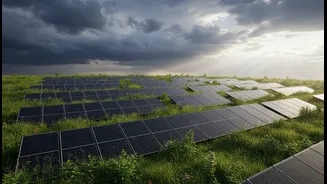
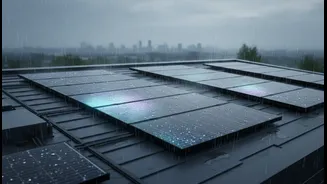
India has made massive strides in solar energy, aiming for ambitious renewable targets. Yet, a fundamental challenge remains: solar panels work best in direct, bright sunlight. During the extended monsoon season, or on any overcast day, power generation
can plummet. Standard solar panels can lose anywhere from 70% to 90% of their output under heavy cloud cover because the sunlight becomes diffuse, or scattered. This intermittency is a major hurdle for grid stability and makes solar a less reliable power source year-round, forcing a continued dependence on fossil fuels when the sun isn't shining. This variability not only affects energy planning but also has a direct financial impact on solar plant operators.
A New Generation of Solar Cells
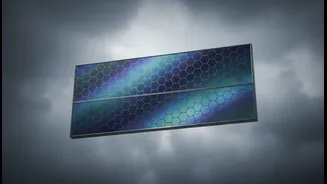
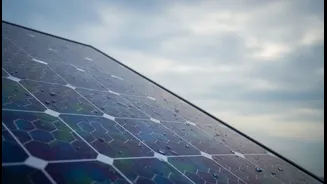
The problem has sent scientists on a quest for solar cells that are not just efficient in ideal conditions, but also effective in low light. The answer lies in materials that can capture a wider spectrum of light, especially the diffuse, blue-tinted light that filters through clouds. Several promising technologies are emerging. While traditional monocrystalline panels are improving, with features like PERC (Passivated Emitter and Rear Cell) technology boosting low-light capture, the most exciting developments are in newer materials. Technologies like TOPCon, Back Contact (BC), and tandem cells are leading the way.
How to Conquer the Clouds
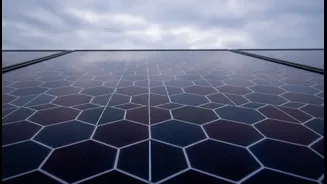
The secret lies in the physics of the materials. Perovskites, a class of crystalline compounds, are a frontrunner. Unlike conventional silicon cells with a fixed light absorption capability, the properties of perovskites can be 'tuned' to better absorb the specific wavelengths of light present on an overcast day. Another powerful approach is the tandem cell, which stacks a perovskite layer on top of a traditional silicon layer. The top perovskite layer captures high-energy blue and green light (prevalent in diffuse light), while the bottom silicon layer captures the lower-energy red and infrared light that passes through. This two-for-one approach significantly boosts overall efficiency, especially when the sun isn't at its brightest.
From the Lab to Indian Rooftops
While these technologies show incredible promise, there are hurdles to overcome before they become commonplace. For perovskites, the main challenges have been stability and durability; early versions degraded quickly when exposed to moisture and heat, though significant progress is being made. Scalability and cost are other major considerations. Manufacturing these advanced cells at the massive scale India requires, and at a price competitive with existing silicon panels, is the next great challenge. However, as production techniques improve and costs fall, these technologies are moving closer to commercial viability. Chinese firm LONGi, for example, has already achieved record efficiencies with its tandem cells.
Reimagining India's Energy Future
The implications for India are enormous. Imagine solar power that remains robust and reliable through the four months of monsoon. It would mean greater grid stability, reduced need for carbon-heavy backup power plants, and a more resilient energy infrastructure. For a country committed to achieving net-zero emissions, a solar solution that works well in all weather is not just a convenience—it's a necessity. This technology could accelerate the adoption of solar power in regions that were previously considered less suitable, such as the Northeast, which experiences heavy and prolonged cloud cover. It would make rooftop solar a more attractive proposition for homeowners and businesses, providing a more consistent return on investment throughout the year.