







A Moon That's More Like a Planet
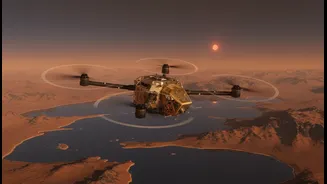
Titan is an anomaly in our solar system. It's the only moon with a substantial atmosphere, which is even denser than Earth's. Composed mostly of nitrogen, like our own air, Titan's atmosphere also features methane clouds that rain liquid methane into
rivers, lakes, and seas. This landscape of flowing liquid and organic-rich dunes under a hazy orange sky makes Titan feel eerily familiar, yet profoundly alien. Scientists believe Titan today may be a frozen analogue of the very early Earth, preserving chemical clues about how the building blocks of life might form. This potential makes it a prime target for astrobiology—the study of life's origins and potential existence beyond Earth.
An Aviator's Dream... and Nightmare
The combination of Titan's thick atmosphere and low gravity (just 14% of Earth's) makes it an ideal environment for flight. The atmosphere is about four times denser at the surface than Earth's, meaning that generating lift is remarkably easy. The power needed for a craft to fly on Titan is about 40 times less than what would be required on Earth. In theory, a human could strap on a pair of wings and fly through its skies with muscle power alone. However, this dream scenario is complicated by harsh realities. The surface temperature is a frigid -180 degrees Celsius (-290 Fahrenheit), cold enough to make materials brittle. The thick, hazy atmosphere blocks most sunlight, making solar power impractical. Furthermore, the great distance from Earth means any robotic explorer must operate with a high degree of autonomy, as real-time communication is impossible.
Enter Dragonfly: A Revolutionary Explorer
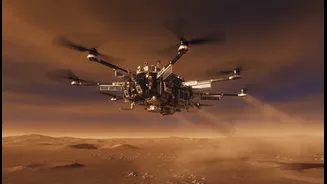
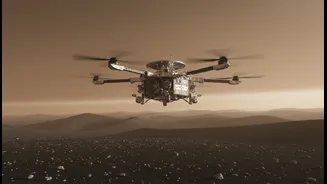
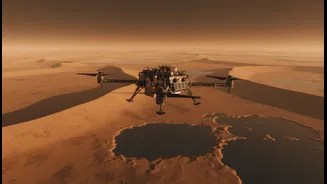
This is where NASA's Dragonfly mission comes in. Scheduled to launch in July 2028 and arrive at Titan in 2034, Dragonfly is a car-sized, nuclear-powered rotorcraft. It's essentially a giant drone, a dual-quadcopter with eight rotors designed to take full advantage of Titan's unique flight-friendly conditions. Unlike stationary landers or slow-moving rovers, Dragonfly will be able to fly between dozens of diverse locations, covering hundreds of kilometers during its mission. This mobility is revolutionary, allowing scientists to sample materials from a wide range of geologic settings—from the organic-rich sand dunes to the floor of an impact crater where liquid water may have once mixed with complex organic materials. By flying from site to site, Dragonfly can accomplish in minutes what would take a rover years, if it were possible at all.
The Science and The Stakes
Dragonfly is more than just an ambitious engineering feat; it's a mobile chemistry lab on a mission to answer some of science's biggest questions. Its primary goal is to investigate prebiotic chemistry—the steps that can lead from simple organic molecules to life. It will carry a suite of instruments, including a mass spectrometer to analyze the composition of surface samples and a seismometer to study the moon's subsurface, which is believed to harbor a liquid water ocean. The mission isn't looking for existing life, but rather for 'biosignatures'—the chemical fingerprints that could indicate that life-forming processes are, or were once, active. Dragonfly will be powered by a Multi-Mission Radioisotope Thermoelectric Generator (MMRTG), the same reliable nuclear source that powers the Curiosity rover on Mars. This provides both electricity and crucial heat to keep the vehicle's systems warm in the extreme cold.