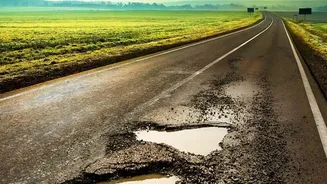







The Annual Pothole Problem
Every year, heavy rainfall wreaks havoc on roads across India. Water is a formidable enemy of asphalt. It seeps into tiny cracks, and the pressure from passing vehicles weakens the structure from within. Over time, these minor fissures expand, leading
to the potholes that damage vehicles, slow traffic, and create significant safety hazards. The cycle of damage and repair is costly and disruptive, with road crews constantly playing catch-up. This annual repair cycle consumes significant budgets and resources that could be used for other public works. The constant need for patchwork repairs means roads are often in a perpetual state of maintenance, leading to traffic disruption and increased carbon emissions from slow-moving vehicles and repair machinery.
Introducing Self-Healing Asphalt
Imagine a road that, when a micro-crack appears, can automatically mend itself before the damage becomes a major problem. This is the promise of self-healing asphalt, an innovative approach to road construction that is moving from research labs to real-world pilot projects. Instead of relying solely on external repair crews, this technology embeds the healing mechanism directly into the asphalt mixture itself. The goal is to extend the lifespan of pavements, reduce maintenance costs, and create more resilient and sustainable infrastructure. The concept is inspired by natural processes, like how living organisms heal their wounds.
The Science of Repair
There are several fascinating methods being developed to achieve self-healing roads. One popular technique involves embedding tiny microcapsules filled with a rejuvenating agent into the asphalt mix. When a crack forms, it ruptures the capsules, releasing the oily substance. This rejuvenator softens the surrounding aged and brittle bitumen, allowing it to flow, seal the crack, and restore the road's integrity. Another method involves mixing conductive fibres, such as steel wool, into the asphalt. When the road shows signs of wear, an induction machine passes over the surface, generating a magnetic field that heats the fibres. The heat melts the surrounding bitumen, which then flows into the micro-cracks and seals them. Researchers are also exploring bio-based solutions, using specific types of bacteria or materials derived from biomass, such as lignin or waste cooking oils, to create binders that can repair damage.
Benefits Beyond a Smoother Ride
The advantages of self-healing roads extend far beyond just preventing potholes. By extending the lifespan of road surfaces, this technology can lead to massive long-term cost savings for governments and taxpayers. Less frequent repairs mean fewer traffic jams, reduced fuel consumption for idling vehicles, and lower carbon emissions associated with road maintenance machinery. Roads would be safer, with a reduced risk of accidents caused by hazardous surface conditions. Furthermore, using bio-based materials in some of these technologies can also contribute to sustainability goals by replacing petroleum-based components with renewable resources and even locking away carbon. Studies suggest self-healing asphalt could reduce the need for repairs by as much as 30%.
Challenges on the Road Ahead
While the technology is promising, widespread adoption faces hurdles. The primary challenge is the high initial cost. The specialized materials, whether microcapsules or steel fibres, make self-healing asphalt more expensive to produce than traditional mixes. There is also a need for specialized equipment, like induction heating machines for the steel fibre method, which requires investment and training. Researchers are still working to optimize the formulas for different climates and traffic loads to ensure long-term performance and durability. However, as the technology matures and scales up, these costs are expected to decrease. In India, institutions like the Central Road Research Institute (CRRI) and IIT-Madras are already experimenting with variants suited for local conditions, suggesting a move from pilot projects to mainstream adoption could be on the horizon.