


The Goldilocks Zone Revisited
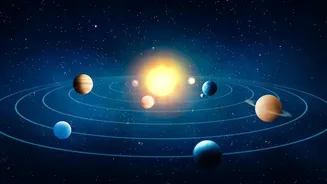
In the cosmic hunt for habitable worlds, the first question is usually about location. Scientists look for planets in the 'circumstellar habitable zone' — a region around a star where conditions are just right for liquid water to exist on a planet's surface.
Too close to the star, and water would boil away. Too far, and it would freeze into a permanent ice world. Earth, of course, sits comfortably within our sun's habitable zone. For years, finding a rocky planet in this temperate band was the primary goal for astronomers, giving us a list of potential candidates for follow-up study. But as our understanding of planetary science deepens, it's becoming clear that a prime orbital address is only one part of a much more complicated habitability puzzle.
Why An Atmosphere is Everything
A planet's ability to host life depends critically on its atmosphere. An atmosphere provides the necessary surface pressure to keep water in a liquid state, shields the surface from harmful cosmic radiation, and, through the greenhouse effect, traps heat to maintain a stable climate. Water vapour itself is a powerful greenhouse gas; without it, Earth's average temperature would be well below freezing. This is where the simple Goldilocks idea starts to break down. A planet's distance from its star doesn't guarantee a life-friendly atmosphere. You need the right ingredients, and one of the most important of those ingredients is gravity, which is a direct function of a planet's size and mass.
The Size-Gravity Connection
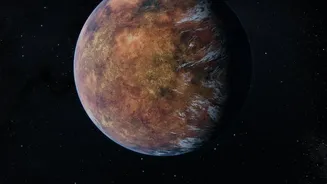
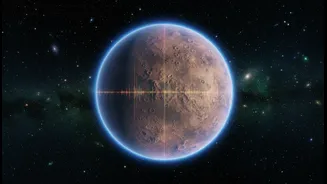
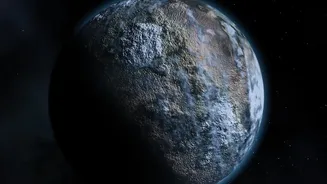
Planet size plays two competing roles in habitability. On the one hand, a planet needs to be massive enough to hold onto its atmosphere over billions of years. A small world, like Mars, has weak gravity and has lost most of its once-thicker atmosphere to space. Recent models suggest a planet needs to have a radius of at least 80% of Earth's to maintain its atmosphere for the long haul. Any smaller, and it risks losing its protective blanket within a billion years, likely before complex life could ever evolve. This sets a minimum size requirement for a world to be considered a viable candidate for life.
The Runaway Greenhouse Problem
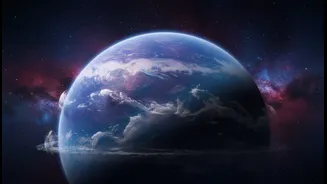
On the other hand, being too big can be just as bad, especially if the planet is on the inner edge of the habitable zone. A larger planet, a so-called "super-Earth," has much stronger gravity. This allows it to hold onto a very thick, dense atmosphere. If this massive planet receives just a little too much energy from its star, that dense atmosphere can trap an enormous amount of heat. This can trigger a 'runaway greenhouse effect,' where rising temperatures cause more water to evaporate, which in turn traps more heat, creating a vicious cycle. This unstoppable process can boil a planet's oceans away entirely and raise surface temperatures to over 1,000 degrees Celsius, turning a potentially habitable world into a sterile pressure cooker like our neighbour, Venus.
A Narrower, More Complicated Path to Life
This means that for larger planets, the habitable zone is effectively narrower and pushed farther away from the star. A super-Earth might need to orbit at a distance that would be too cold for a planet like Earth, simply because its own immense gravity and thick atmosphere make it so much better at retaining heat. This nuanced understanding helps scientists refine their search. Instead of just looking for any rocky planet in the habitable zone, they can now filter their targets. A small planet close to its star might be a poor candidate, liable to have its atmosphere stripped away. A very large planet on the inner edge of the habitable zone might be a runaway greenhouse in waiting. The search is now for planets that have the right size and the right orbit, a combination that allows for a stable, life-friendly climate to persist for eons.