


The Veiled Cradles of Creation
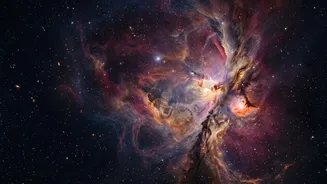
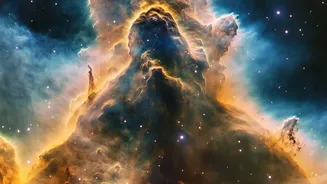
Imagine a nursery so shrouded in dust that no visible light can escape. This is the reality for star-forming regions, colossal clouds of cold gas and dust known as molecular clouds. For decades, these stellar nurseries, like the famous Pillars of Creation
in the Eagle Nebula or the Orion Nebula, have captivated astronomers. Yet, they remained largely mysterious. Telescopes like Hubble, which primarily see in visible and ultraviolet light, are blinded by the thick dust, much like car headlights in a dense fog. This cosmic dust, composed of tiny particles, effectively blocks our view of the processes happening deep inside, where gravity is slowly pulling material together to ignite new suns. We could see the beautiful exterior of these clouds, but the crucial moments of 'cosmic birth' were happening behind a seemingly impenetrable veil.
Webb’s Unprecedented Infrared Vision
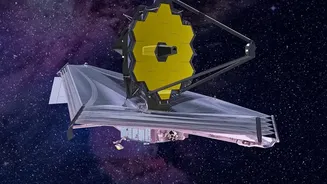
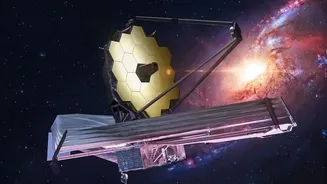
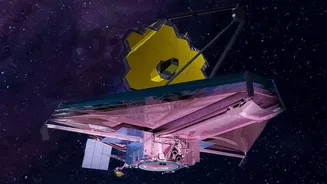
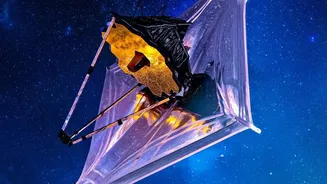
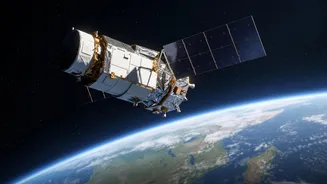
The James Webb Space Telescope (JWST) was engineered specifically to solve this problem. Observing the universe in infrared light, which our eyes perceive as heat, Webb can detect wavelengths that are much longer than visible light. These longer wavelengths can travel through the dense dust clouds that obscure visible light, allowing the telescope to peer inside the nurseries and witness star formation in real time. It's the astronomical equivalent of having X-ray vision. Suddenly, regions that were dark and opaque to Hubble are revealed in breathtaking detail. This capability has fundamentally transformed our ability to study not just how stars are born, but also the chaotic and beautiful environments they create.
What Cosmic Birth Actually Looks Like
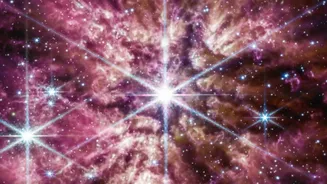
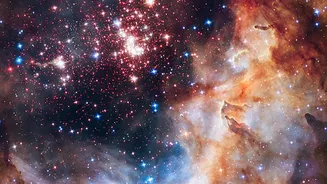
So, what has Webb shown us? The images are far from tranquil. Inside these nurseries, we see protostars—infant stars still gathering mass from their surrounding cocoons of gas and dust. Many of these baby stars are incredibly active. They shoot out powerful, opposing jets of material into space. In Webb's images, these jets appear as brilliant red streams, carving out huge cavities in the surrounding nebula. One stunning image of the protostar inside L1527 shows a fiery hourglass shape, where the star itself is hidden within a dark lane of dust at the narrowest point. In other regions, like the 'Cosmic Cliffs' of the Carina Nebula, the intense radiation from massive young stars sculpts the surrounding gas and dust into dramatic landscapes of cliffs and valleys. Webb reveals a dynamic, violent, and messy process of creation.
From Galactic Recycling to Our Own Sun
Studying these stellar nurseries is about more than just capturing beautiful images. It's a journey into our own cosmic origins. The process of star formation is a key part of galactic evolution. The material that forms new stars was forged inside previous generations of stars, making it a grand story of cosmic recycling. By watching new stars and their planetary systems form, scientists can gather clues about how our own solar system came to be over 4.5 billion years ago. The environments Webb is observing are thought to be similar to the one in which our sun was born. Each image of a protostar's disk or a jet from a young star allows researchers to witness a brief, crucial period in the stellar lifecycle with newfound clarity. It helps astronomers refine their models of both star and planet formation, answering fundamental questions about our place in the universe.