
The Sun’s Turbulent Outbursts
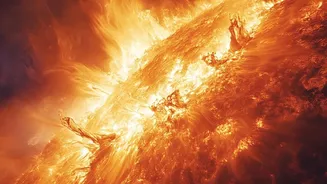
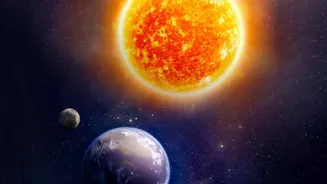
Our star is a dynamic and sometimes volatile ball of hot plasma. Its intense magnetic fields can twist and snap, unleashing tremendous bursts of energy. The two main types of solar outbursts are solar flares and coronal mass ejections (CMEs). A solar flare is a powerful
flash of radiation, which travels at the speed of light and reaches Earth in about eight minutes. A CME, on the other hand, is a massive eruption of magnetised plasma from the sun's outer atmosphere, the corona. These clouds of charged particles travel more slowly, taking anywhere from 12 hours to several days to cross the 150-million-kilometre distance to our planet. While flares can cause immediate radio blackouts on the sunlit side of Earth, it is the powerful CMEs that pose the greatest risk to our infrastructure by triggering geomagnetic storms.
When a Solar Storm Hits Earth
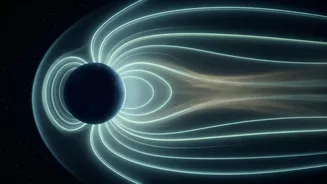
Earth is protected by a magnetic field, the magnetosphere, which deflects most of the constant stream of solar particles. However, a powerful CME can distort and weaken this magnetic shield, allowing energised particles to penetrate our upper atmosphere. This interaction generates geomagnetically induced currents (GICs) that can flow through the Earth's surface and into long electrical conductors. The result is a geomagnetic storm, a major disturbance of our planet's magnetic field that can have wide-ranging effects on technology both in space and on the ground. While these storms are also responsible for creating beautiful auroras, their impact on our digital world can be far less serene.
Satellites and GPS on the Front Line
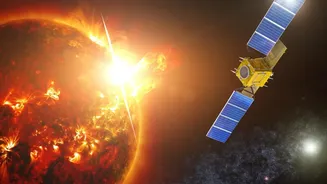
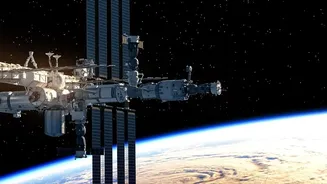
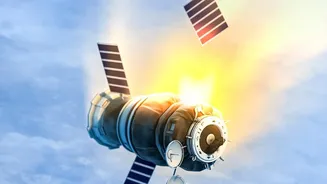
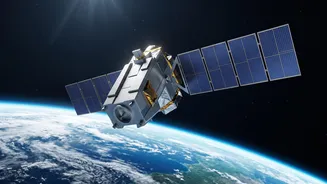
Satellites orbiting outside Earth’s protective atmosphere are highly vulnerable. The influx of high-energy particles can damage sensitive electronics, degrade solar panels, and cause phantom commands that disrupt operations. Extreme storms also heat and expand Earth's upper atmosphere, increasing the drag on satellites in low-Earth orbit. This can cause them to lose altitude and even re-enter the atmosphere prematurely. This directly impacts Global Positioning System (GPS) services. The signals from GPS satellites are delayed and distorted as they pass through a disturbed ionosphere, leading to positioning errors that can range from a few metres to a complete loss of signal. This affects not just navigation apps but also critical sectors like aviation, shipping, and precision agriculture that rely on accurate timing signals.
The Threat to Power Grids and the Internet
The geomagnetically induced currents from a major storm pose a serious threat to our power grids. These currents can flow into long-distance transmission lines and overload high-voltage transformers, causing them to overheat and fail. This could lead to widespread and long-lasting blackouts, as seen during the 1989 storm that caused the collapse of Quebec's entire power grid. The internet is also at risk. While fibre-optic cables themselves are immune to geomagnetic currents, the signal-boosting repeaters placed along undersea cables are not. A severe storm could damage these repeaters, potentially severing inter-continental internet connections for weeks or months. Furthermore, since the entire internet infrastructure depends on a stable power supply, a grid failure would result in local and regional internet outages.
A Historical Warning: The Carrington Event
To understand the worst-case scenario, we look back to 1859. The Carrington Event, the most intense geomagnetic storm in recorded history, was triggered by a massive solar flare and CME. In a world powered by steam and early electricity, its effects were dramatic. Telegraph systems across North America and Europe failed, with reports of operators receiving electric shocks and telegraph paper catching fire. Auroras were seen as far south as the Caribbean. Some telegraph operators were even able to send messages with their power supplies disconnected, running on the storm's induced current alone. If a storm of this magnitude were to strike our modern, technology-reliant society, the disruption to power grids, satellites, and communications would be catastrophic, potentially causing damage that could take years to repair.