



Humanoid robots have stepped out of the lab and into the spotlight, with major companies like BMW, Mercedes-Benz, and Amazon testing them in factories and warehouses. But behind the sci-fi sheen, a more complex reality is emerging.
The New Mechanical Workforce
A new wave of automation
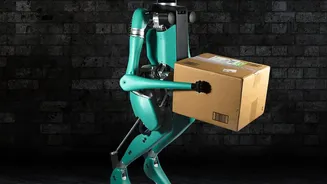
is here, and it walks on two legs. Companies like Figure AI, Agility Robotics, and Apptronik are at the forefront, developing sophisticated humanoid robots capable of performing tasks in environments designed for people. Automaker BMW, for instance, completed a pilot with Figure's robots, which can handle parts with high accuracy, while Mercedes-Benz is testing Apptronik's Apollo for logistics tasks like delivering assembly kits to the production line. Amazon is also testing Agility's bipedal robot, Digit, to move totes in its facilities, aiming to support employees by automating highly repetitive work. The promise is simple and powerful: a robot that can integrate into existing workflows without requiring a complete redesign of the factory or warehouse. This has sparked a surge of investment, with billions pouring into the sector.
Why Now? The Push for Automation
The corporate interest in humanoid robots isn't just about technological novelty; it's a response to pressing economic and demographic trends. Many companies view automation as a solution to persistent labor shortages, particularly for physically demanding, repetitive, or dangerous jobs. The stated goal of many of these pilot programs is not to replace human workers wholesale but to augment them, freeing people from monotonous tasks to focus on more complex work. Furthermore, advocates argue that robots can improve workplace safety by taking over jobs with higher risks of injury. For global manufacturers, staying competitive means constantly seeking efficiency gains, and humanoid robots represent a potential new frontier in that quest.
The Billion-Dollar Question: ROI
Despite the excitement, the most significant hurdle for humanoid robots is proving their economic value. These are not cheap machines. Current unit costs can range from $50,000 to over $250,000, with ongoing software and maintenance fees adding to the total cost of ownership. For example, one model from Agility Robotics could cost a customer around $400,000 over an estimated five-year lifespan. While proponents argue for a fast return on investment, citing the robot's ability to work around the clock, the reality is more complicated. A recent analysis of one prominent pilot showed the robot worked a standard 10-hour shift and performed its task more slowly than the target cycle time and a trained human worker. Until the price drops significantly and the performance reliably exceeds human productivity in more tasks, widespread adoption will remain a tough sell.
Beyond the Demo: Real_World Hurdles
The gap between a controlled demo and a chaotic factory floor is vast. Reliability is the single biggest barrier, with industrial customers demanding 95%–99% uptime, a figure most humanoids currently cannot meet. Battery life is a fundamental constraint, with most robots operating for only 2–4 hours before needing a recharge, making a full 8–hour shift impossible without downtime or hot–swapping batteries. Dexterity and the ability to handle unexpected situations, or 'edge cases', also remain significant software challenges. An object that's slightly out of place or a cluttered aisle can foil a robot that performed perfectly in a predictable lab setting. Finally, safety standards for autonomous, mobile humanoids are still being written, creating regulatory uncertainty for companies looking to deploy them alongside a human workforce.
An Era of Experimentation
Rather than a robotic takeover, 2026 is shaping up to be the year of the pilot program. Companies are not buying fleets of thousands; they are cautiously testing small numbers of robots on very specific, narrow tasks to see what works. The lessons learned from these early deployments are crucial. They reveal the engineering, integration, and operational challenges that must be solved before scaling becomes feasible. Experts note that there is a 'graveyard of pilot projects' where expectations were too high and the business case wasn't solid from the start. The current phase is less about immediate, large–scale deployment and more about generating the real–world data needed to improve the technology and prove its worth. For most businesses, the smart move is not to buy a humanoid robot today, but to learn from these experiments and identify where one might fit in the future.