




How Many Earths Can You Fit Inside?
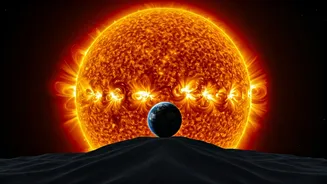
Let’s start with the classic comparison. You could fit approximately 1.3 million Earths inside the Sun. It’s a number so large it’s almost meaningless. So, let’s try another way. The Sun’s diameter is about 864,000 miles. If you were to line up planets
Earth across the face of the Sun, you’d need 109 of them, side by side, just to span the distance. Imagine our entire world—every continent, every ocean—shrunk down to the size of a single marble. In that scenario, the Sun would be a glowing sphere about 10 feet tall. It’s the difference between a grain of sand and a beach ball. This sheer volume is the first hurdle in comprehending our star. It’s not just 'big'; it operates on a completely different plane of existence from anything we experience on our home planet.
The Solar System's True Center of Gravity
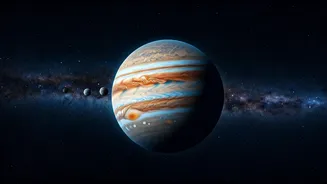
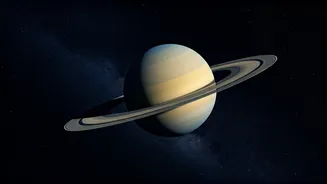
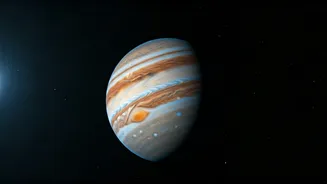
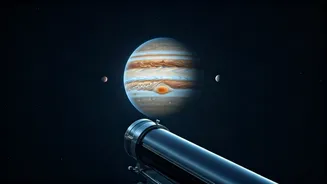
While its size is staggering, the Sun’s mass is where its dominance truly lies. Our star accounts for an almost comical 99.86% of all the mass in the entire solar system. Everything else—every planet, moon, asteroid, and comet, including gas giants like Jupiter and Saturn—is just the leftover 0.14%. Think about that. Jupiter is so massive that all other planets in the solar system could fit inside it. Yet, compared to the Sun, even mighty Jupiter is a cosmic afterthought. This incredible mass generates the immense gravitational pull that holds our solar system together. The planets aren't just circling a bright light; they are tethered to an object of almost absolute gravitational authority. Without this mass, the Earth and its celestial neighbors would simply be rogue objects, drifting aimlessly through the cold, dark void of interstellar space.
A Nuclear Furnace of Epic Proportions
The Sun’s size and mass enable its most vital function: its energy output. At its core, where pressures are immense and temperatures reach 27 million degrees Fahrenheit, the Sun is a gigantic nuclear fusion reactor. Every second, it fuses about 600 million tons of hydrogen into helium. The resulting energy release is almost beyond human language. In a single second, the Sun radiates more energy than humanity has consumed throughout its entire history. The tiny fraction of that energy that strikes Earth is enough to power our climate, drive photosynthesis, and make life itself possible. When you feel the Sun’s warmth on your face, you’re experiencing the fallout from a continuous, controlled thermonuclear explosion happening 93 million miles away, an event so powerful it has sustained itself for 4.6 billion years and will continue for billions more.
Surprisingly Average, and That's a Good Thing
Here is perhaps the most humbling fact of all: for a star, our Sun is not particularly special. Astronomers classify it as a G-type main-sequence star, or a 'yellow dwarf.' It’s far larger than the most common type of star in the galaxy, red dwarfs, which can be as small as the planet Jupiter. However, it is utterly dwarfed by the universe’s true giants. Consider the red hypergiant UY Scuti. If you were to replace our Sun with UY Scuti, its surface would extend out past the orbit of Jupiter, swallowing Mercury, Venus, Earth, and Mars in the process. If our Sun were the size of a front door, UY Scuti would be a sphere wider than a city block. Our 'mind-boggling' star is, on a galactic scale, perfectly average. And that stability is exactly what allows life to flourish here. We exist in the gentle, predictable glow of a common, reliable star—a cosmic blessing of mediocrity.