








At CERN, scientists are peering into the 'zeptoverse', a realm of unimaginably small distances. Using the upgraded Large Hadron Collider beauty (LHCb) experiment, they are achieving unprecedented precision and testing the very fabric of reality.
The Search in the Zeptoverse
Imagine
a world thousands of trillions of times thinner than a human hair. Scientists have dubbed this the 'zeptoverse', and it’s at this scale that the fundamental rules of the universe are written. Buried 100 meters underground on the Franco-Swiss border, the Large Hadron Collider (LHC) at CERN smashes protons together at near-light speed. This creates a shower of exotic, short-lived particles that are typically not found in nature today but were abundant just moments after the Big Bang. One of the LHC's four major experiments, the LHCb, is designed specifically to study some of these fleeting particles, particularly those containing 'beauty' quarks. By watching how these particles decay, physicists hope to answer some of the biggest questions we have, such as why the universe is made of matter and not antimatter.
What is the LHCb Experiment?
Unlike other detectors that surround the entire collision point, the LHCb is a specialised instrument that stretches 20 meters along the beamline, designed to catch the particles that fly forward from the collision. Its primary purpose is to study particles containing beauty quarks. These quarks are incredibly unstable, existing for just a trillionth of a second before transforming into other, lighter particles. The LHCb experiment acts like a super-high-speed camera, recording these decays with incredible precision. A recent major upgrade allows the experiment to collect data up to five times faster than before, giving scientists a much better chance of catching extremely rare events.
A Forty-Year Hunt for a Rare Decay
For over 40 years, physicists have been hunting for a particularly rare process: the decay of a particle called a B-zero meson (B0) into two smaller particles called muons. The Standard Model of particle physics—our best theory for how the universe works—predicts this should happen only about once in every ten billion decays. Finding it is harder than winning the lottery. In November 2026, the LHCb collaboration announced they had finally found the first evidence for this decay using data from a single experiment. Using data collected in 2024 and 2025, combined with earlier results, they reached a statistical significance of 3.2 sigma. While this is enough to be called 'evidence', it's still short of the 5-sigma 'gold standard' needed to claim a formal discovery.
Precision, Not New Particles (Yet)
Interestingly, the result doesn't point to new physics—it actually agrees with the predictions of the Standard Model. So why is it important? These ultra-rare decays are extremely sensitive tests of the Standard Model. If the measured rate was different from the prediction, it could hint at the existence of unknown particles or forces influencing the decay through quantum effects. By confirming the prediction with such high precision, scientists are able to place even tighter constraints on what 'new physics' could be hiding at energy scales beyond the direct reach of the LHC. The result showcases a different path to discovery: not by creating a new particle, but by measuring tiny deviations in rare processes.
The Power of Upgraded Technology
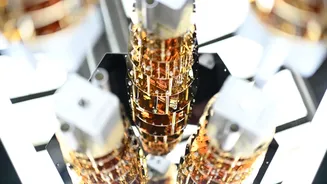
This breakthrough was made possible by the recently upgraded LHCb detector. Key to this is the Vertex Locator (VELO), a sophisticated pixel detector that sits just five millimeters from the particle beam. This proximity allows it to track the particle paths with extreme accuracy. Advanced machine learning techniques were also crucial, helping scientists sift through the data from billions of collisions to isolate the rare signal from the overwhelming background noise. The upgraded system not only collects data faster but also uses a fully software-based trigger system, allowing for more sophisticated analysis of every single collision recorded.