


Seeing the Invisible with Infrared
The fundamental challenge in observing star birth is the very stuff that stars are made of: vast, dense clouds of gas and dust. These stellar nurseries are so thick that they block visible light, leaving telescopes like Hubble unable to see the action
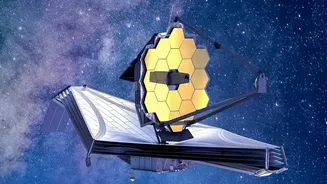
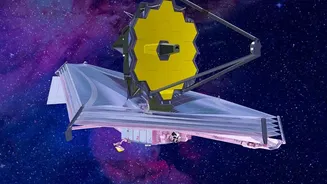
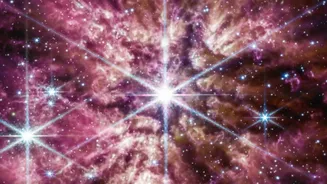
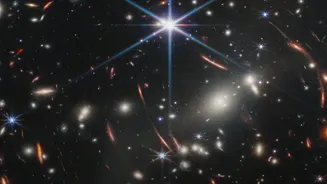
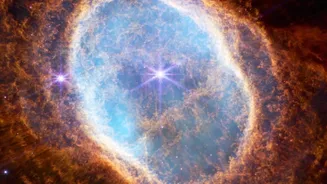
within. This is where the James Webb Space Telescope’s magic comes in. JWST is designed to see the universe in infrared light. This longer wavelength of light can pass through the dense dust clouds, much like X-rays pass through soft tissue to reveal bones. This capability allows astronomers to finally peer inside the cocoons where stars are forming, revealing processes that were previously only theoretical. By capturing this once-hidden light, JWST is providing the first clear views of the earliest and most chaotic stages of stellar creation.
A New Look at Stellar Nurseries
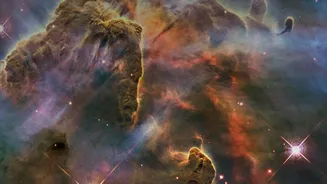
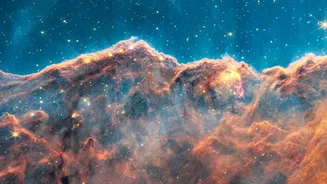
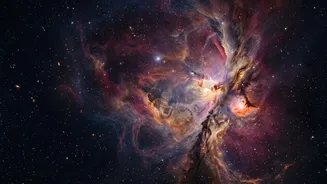
One of JWST's most iconic early images, the 'Cosmic Cliffs' in the Carina Nebula, showcases its power perfectly. What appears to be a rugged mountain range is actually the edge of a giant, gaseous cavity carved out by intense radiation from massive young stars. Within this cosmic landscape, Webb’s infrared sensitivity has unveiled hundreds of previously hidden stars. It reveals dramatic pillars of gas resisting erosion from stellar winds and captures the tell-tale golden jets of material being blasted out by protostars — infant stars still gathering mass. This period of early star formation is fleeting, lasting only 50,000 to 100,000 years for an individual star, making Webb's ability to chronicle this rare event a monumental achievement.
Watching Protostars and Their Jets
JWST is providing revolutionary details about protostars and the energetic outflows they produce, known as Herbig-Haro objects. These objects are formed when jets of gas, spewing from a newborn star at hundreds of kilometres per second, slam into the surrounding gas and dust, creating glowing shockwaves. Webb’s detailed images of objects like HH 49/50 and HH 797 allow astronomers to trace the structure of these jets with incredible precision. By observing molecules like hydrogen and carbon monoxide in these outflows, scientists can better understand how a young star’s energetic activity shapes its immediate environment, potentially influencing how future planets might form in the system.
The Ingredients for New Worlds
Perhaps most excitingly, JWST is not just seeing new stars; it's seeing the birth of their future planets. Surrounding many young stars are swirling 'pancakes' of gas and dust called protoplanetary disks. It is within these disks that planets are built. For the first time, JWST's instruments are able to perform detailed chemical analysis of the material within these disks. Astronomers have detected the clear signatures of water, carbon dioxide, and complex organic molecules like acetylene in the planet-forming regions around young stars. This confirms that the basic chemical ingredients necessary for life as we know it are present at the earliest stages of a solar system's formation, offering profound clues about our own origins.
Rewriting the Timelines
Recent studies using JWST data are also challenging long-held assumptions about how planetary systems evolve. One major discovery is that the way a disk loses its gas changes over time. In very young systems, powerful, magnetically driven jets and winds clear out material, but in older systems, the star's own radiation becomes the dominant force in dispersing the gas. This process creates a race against time for giant planets like Jupiter, which must gather their huge atmospheres before the gas is blown away. Additionally, observations of small, low-mass stars have shown their planet-forming disks can last for 30 million years or more—three times longer than previously expected. This extended timeline could provide a longer, more stable window for planets to form around these common types of stars.