





The Challenge of Launching Big
Every kilogram sent into orbit costs a fortune, and rockets have a finite amount of space in their payload fairings, the nose cones that protect cargo during launch. Historically, this has meant that space station modules had to be small and dense. The
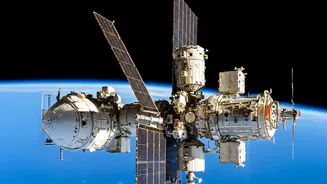
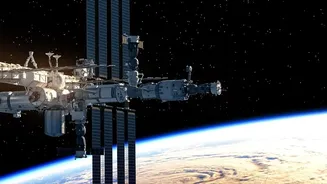
International Space Station (ISS), a modern marvel of engineering, was assembled piece by piece over dozens of launches, a costly and complex process. For astronauts, this results in living and working in relatively confined quarters, a psychological and logistical strain on missions that can last for months or even years. To truly establish a long-term human presence in space, we need more room—for science, for living, and for a better quality of life.
An Inflationary Solution
Enter the concept of expandable, or inflatable, habitats. The idea, which NASA began exploring as early as the 1960s, is simple in principle: launch a module that is tightly packed and folded, then inflate it to its full size once in orbit. This allows a single rocket launch to deliver a habitat with vastly more internal volume than a traditional rigid module of the same mass. Forget party balloons; these are highly advanced structures made of multiple layers of high-tech fabrics. They are designed not just to hold air but to protect astronauts from the harsh realities of space, including radiation, extreme temperatures, and impacts from micrometeoroids and orbital debris.
Layers of Protection
The secret to an expandable habitat's strength lies in its sophisticated, multi-layer skin. On the inside, an airtight bladder holds the breathable atmosphere. Surrounding this is a structural restraint layer made from incredibly strong, woven materials like Vectran, a fabric that is five times stronger than steel. This layer is what contains the pressure and gives the module its shape. The outermost layers form a shield. Often incorporating materials like Kevlar, this tough exterior is designed to break up and absorb the energy from tiny space debris traveling at hypersonic speeds, a critical safety feature for any long-term habitat. This layered approach has proven to be as effective, and in some cases more so, than the solid aluminum walls of traditional modules.
BEAM: A Test Case on the ISS
The first major real-world test of this technology for human use is the Bigelow Expandable Activity Module (BEAM). Developed by Bigelow Aerospace under a NASA contract, BEAM was launched to the ISS in 2016 in a compressed state. Once attached to the station's Tranquility node, it was carefully inflated over several hours. Initially planned for a two-year test, BEAM has far exceeded expectations, proving its durability and reliability. It has demonstrated excellent performance in maintaining pressure and protecting against radiation and debris. As of 2026, it remains attached to the ISS, where it serves as a valuable storage space, freeing up room in other modules and providing continuous data on the long-term performance of expandable structures.
The Next Generation of Space Real Estate
With the success of BEAM, the private space industry is moving forward with even more ambitious designs. A leading example is the LIFE (Large Integrated Flexible Environment) habitat from Sierra Space. Designed to be a core component of future commercial space stations like Orbital Reef, a single LIFE module inflates to a structure three stories tall, offering a vast interior that can house four astronauts, a science lab, an exercise area, and more. These next-generation modules are central to plans for replacing the aging ISS, which is scheduled for retirement around 2030. Companies like Sierra Space, Lockheed Martin, and Max Space are all developing expandable technologies, viewing them as a cost-effective way to build the commercial outposts that will define the future of low-Earth orbit.