






A Library of Ancient Atmospheres
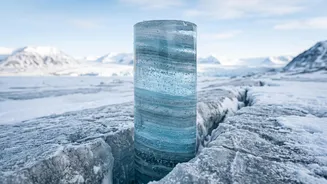
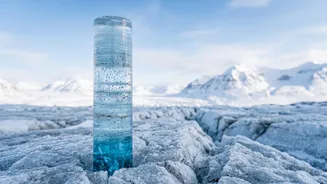
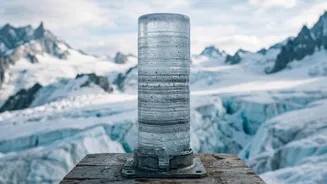
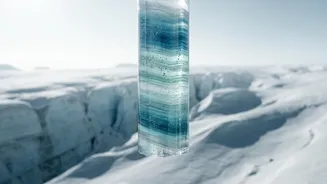
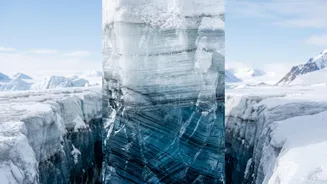
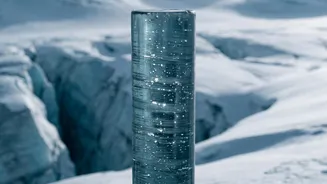
For hundreds of thousands of years, snow has fallen over the polar regions, piling up layer by layer. As the snow gets buried and compressed, it slowly turns into solid ice. In this process, tiny pockets of the surrounding air get trapped, forming bubbles
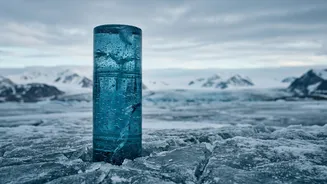
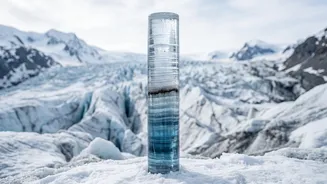
that are preserved for millennia. Scientists can drill deep into this ice, sometimes over three kilometers down, to extract cylinders of ice called 'ice cores'. These cores are like a library of Earth's atmospheric history, with the oldest ice at the bottom containing air from as far back as 800,000 years. Each bubble is a direct sample of the atmosphere at the moment it was trapped, offering an unparalleled record of the past.
The Science of Reading the Bubbles
Extracting this ancient information is a meticulous process. Once an ice core is drilled and brought to a laboratory, it is kept at frigid temperatures to ensure it remains pristine. Scientists then carefully cut sections of the ice and place them in a vacuum chamber. As the ice is melted or crushed, it releases the trapped air from the bubbles. This ancient air is then analyzed using sophisticated instruments. Researchers can precisely measure the concentrations of key greenhouse gases like carbon dioxide (CO2), methane (CH4), and nitrous oxide. This isn't an estimate or a proxy; it's a direct measurement of the air our ancestors breathed thousands of years ago, providing a clear history of the gases that regulate our planet's temperature.
A Stark Historical Record
The story these bubbles tell is one of the most important discoveries in modern science. For 800,000 years, CO2 levels in the atmosphere naturally fluctuated between about 180 and 300 parts per million (ppm). These cycles corresponded closely with the planet's ice ages and warmer interglacial periods. The data shows an undeniable link: when CO2 was high, the planet was warm, and when CO2 was low, the planet was cold. However, the record since the Industrial Revolution shows a dramatic and unprecedented spike. Current CO2 levels are far higher than at any point in the last 800,000 years. The rate of this increase is also unmatched in the geological record, confirming that recent changes are not part of the natural cycle.
From Data to Decisive Action
This is where ancient ice empowers modern action. The data from ice cores provides the undeniable 'before' picture, giving us a baseline to understand the magnitude of human impact. This historical evidence is a cornerstone of the climate models used by scientists to project future warming. By successfully simulating past climates recorded in the ice, scientists can validate their models, giving them much greater confidence in their predictions for our future. This confidence is crucial. It transforms the climate debate from one of theory to one based on hard evidence. It provides the solid scientific foundation that policymakers need to forge international agreements and implement national strategies aimed at reducing emissions. The bubbles don't just tell us about the past; they provide the proof needed to justify urgent action in the present and protect the future.