



The Villain in Our Food: What Are Trans Fats?
Before we celebrate the purity of traditional sesame oil, it is crucial to understand what we are avoiding. Trans fats, or trans-fatty acids, are a type of unsaturated fat that is particularly bad for your health. Unlike other fats, they raise your 'bad'
(LDL) cholesterol while simultaneously lowering your 'good' (HDL) cholesterol. This double impact significantly increases the risk of heart disease, stroke, and other inflammatory conditions. While small amounts of trans fats occur naturally in some animal products, the primary source in modern diets is industrially produced partially hydrogenated oils. This is where the extraction method becomes the hero or villain of the story.
The Ancient Method: Mara Chekku
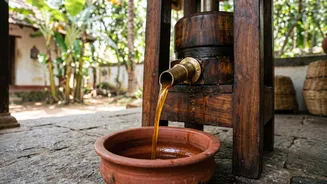
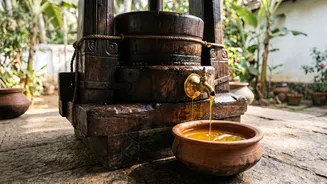
The traditional South Indian method for extracting sesame oil uses a 'chekku' or 'ghani'. In its most authentic form, this is a 'mara chekku', a large wooden press powered by bullocks, though modern versions may use a slow-moving electric motor. Sesame seeds are placed into a pit and crushed by a heavy, rotating wooden pestle. The key here is the material and the speed. The wooden components prevent heat from building up due to friction, and the slow, mechanical pressing gently coaxes the oil from the seeds. This process happens at or near room temperature, which is why it's called 'cold-pressing'. The result is a pure, unrefined oil that retains the full nutritional profile of the sesame seeds.
Industrial Refining: A Story of Heat and Chemicals
Commercially refined oils, on the other hand, are designed for mass production, long shelf life, and a neutral taste. The process involves high heat, pressure, and chemical solvents like hexane to extract every last drop of oil. After extraction, the crude oil undergoes several more stages: degumming, neutralization, bleaching, and, most critically, deodorization. The deodorization stage, which removes strong smells and flavours, subjects the oil to extremely high temperatures, often exceeding 200°C. It's this intense heat that can alter the molecular structure of the oil's healthy unsaturated fats, creating harmful trans fats in the process.
Why Cold-Pressing Prevents Trans Fats
The secret to keeping South Indian cold-pressed sesame oil free from trans fats lies in its gentle, low-temperature process. Because the oil is never exposed to the high heat of industrial refining and deodorization, its natural fatty acid structure remains stable and unaltered. There is no hydrogenation and no chemical intervention. The process simply separates the oil from the seed in its natural state. Studies have confirmed that while refined oils can contain trans fat isomers due to processing, traditionally cold-pressed oils do not. This ancient method inherently protects the oil's integrity, ensuring you get all the goodness without any of the industrially created harm.
Beyond Trans Fats: More Benefits of Chekku Oil
The absence of trans fats is just one part of the story. The low-temperature extraction of chekku oil preserves a wealth of other beneficial compounds that are often destroyed by industrial refining. Cold-pressed sesame oil is rich in natural antioxidants like sesamol and sesamin, which combat cellular damage. It also retains its Vitamin E, heart-healthy polyunsaturated and monounsaturated fats, and minerals like zinc and copper. This nutrient density contributes to its anti-inflammatory properties, its ability to support good cholesterol levels, and its renowned benefits for skin and hair health, making it a staple in Ayurveda for centuries.