



A New 'Eye in the Sky'
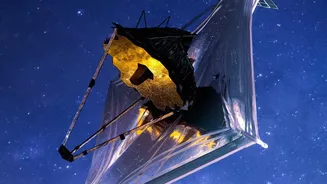
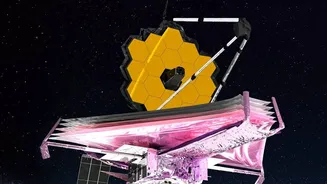
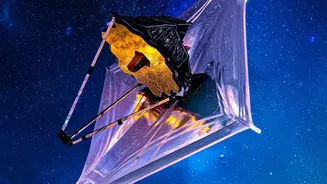
Named after Nancy Grace Roman, NASA’s first chief of astronomy and the “mother of Hubble,” this new telescope is poised to build on the legacy of its predecessors. Launched on August 30, 2026, aboard a SpaceX Falcon Heavy rocket, the Roman Space Telescope
is now on its way to an orbit one million miles from Earth. While its primary mirror is the same size as the Hubble Space Telescope's, at 2.4 meters, Roman’s power lies in its incredibly wide field of view. Its Wide Field Instrument (WFI) can capture an area of the sky at least 100 times larger than Hubble can in a single snapshot, with the same exquisite detail. This panoramic capability means that where Hubble sees a keyhole, Roman will see the entire door, allowing it to map vast regions of space with unprecedented speed.
The Hunt for Dark Energy
One of Roman’s primary objectives is to confront the mystery of dark energy. This enigmatic force is believed to be responsible for the accelerating expansion of the universe, a discovery that challenged long-held cosmological models. Dark energy is thought to make up about 68% of the universe, but its true nature remains unknown. Roman will investigate it by surveying billions of galaxies and thousands of distant stellar explosions called Type Ia supernovae. By precisely measuring their distances and how their light has been stretched over time, astronomers can chart the expansion history of the universe. This will help determine if dark energy is a constant force or if it has changed over cosmic history, a question with profound implications for the ultimate fate of our universe.
A Census of Alien Worlds
Beyond cosmology, Roman is set to revolutionize the search for exoplanets—planets orbiting other stars. While previous missions have found thousands of exoplanets, they have primarily used the transit method, which is best at finding large planets orbiting very close to their stars. Roman will employ a powerful technique called gravitational microlensing. This method, predicted by Einstein, occurs when a star and its planets pass in front of a more distant star, causing the background starlight to be briefly magnified by gravity. This technique is sensitive enough to find planets with masses as small as Mars, as well as worlds orbiting far from their star, including analogs to the ice giants in our own solar system. Roman is expected to discover thousands of new worlds, including a significant population of free-floating 'rogue' planets that wander the galaxy untethered to a star.
More Than a Telescope
In addition to its two main surveys, Roman carries a technology demonstrator called the Coronagraph Instrument. This device is designed to block the overwhelming glare of a star, allowing for the direct imaging of the faint planets orbiting it—a feat often compared to spotting a firefly next to a searchlight. While the coronagraph will only observe a small number of nearby systems, it will serve as a crucial testbed for technologies needed for future missions, like the Habitable Worlds Observatory, which aims to search for signs of life on Earth-like planets. Roman’s vast surveys will also create an enormous atlas of the cosmos, providing data that will fuel astronomical discoveries for decades to come across a wide range of fields.