


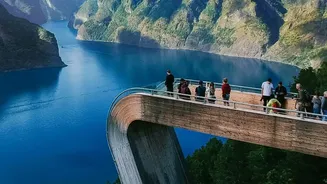
Carved by ancient glaciers, Europe's fjords offer some of the most dramatic landscapes on Earth. While several countries boast these stunning sea-inlets, Norway is in a class of its own, home to two of the most spectacular examples anywhere.
Geirangerfjord: The Postcard-Perfect Wonder
Often hailed
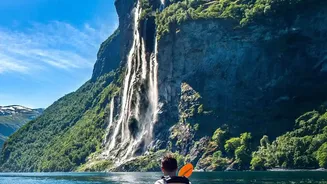
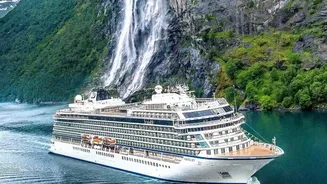
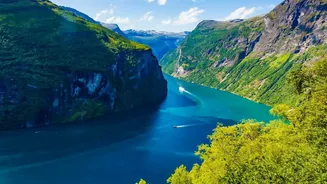
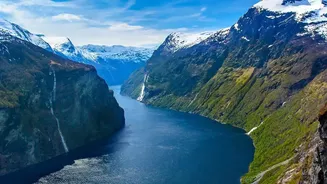
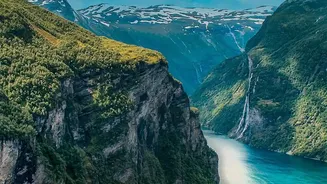
as the jewel in the crown of the Norwegian fjords, the Geirangerfjord is a 15-kilometre branch of the larger Storfjord. Its reputation is built on raw, concentrated beauty. Since 2005, it has been jointly recognised with the Nærøyfjord as a UNESCO World Heritage site for its exceptional natural significance. The fjord is framed by near-vertical mountain walls rising up to 1,700 metres from the sea, creating a breathtaking amphitheatre of rock and water. Its most famous sights are the waterfalls that cascade down its cliffs. The Seven Sisters, the Suitor, and the Bridal Veil are legendary, tumbling hundreds of metres into the sapphire water below. Dotted along the cliffs are abandoned mountain farms, known as 'fjordgårder', which cling to impossibly steep ledges and tell a story of a hardy, resilient past. The best way to experience Geirangerfjord is from the water. A ferry cruise between the villages of Geiranger and Hellesylt puts you directly beneath the towering falls. For a more active adventure, kayaking and RIB boat tours offer a chance to get even closer to the spray.
Nærøyfjord: The Narrow and Dramatic Channel
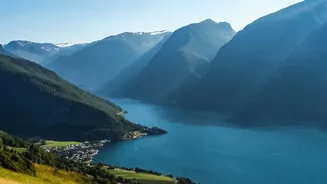
While Geirangerfjord is known for its open grandeur, the Nærøyfjord offers a different kind of drama: intimacy and scale. Also a UNESCO World Heritage site, it is a 17-kilometre-long arm of the vast Sognefjord. What makes Nærøyfjord globally unique is its narrowness; at one point, it is only 250 metres wide, making it one of the narrowest navigable fjords in the world. Sailing through it feels like journeying through a canyon, with sheer cliffs soaring over 1,700 metres high on either side. The confined space amplifies the sense of nature's power. Waterfalls stream down the dark rock faces, and the calm waters are often home to seals and porpoises. Because of its tranquil and enclosed nature, Nærøyfjord is perfectly suited for silent, electric boat tours that glide through the water with minimal disturbance. These cruises typically run between the villages of Gudvangen and Flåm and are a core component of the popular 'Norway in a Nutshell' tour, making it one of the most accessible fjord experiences from major cities like Bergen and Oslo.
Sognefjord: The King of the Fjords
You cannot talk about Nærøyfjord without mentioning its parent, the mighty Sognefjord. Nicknamed the 'King of the Fjords', it is Norway's longest and deepest, stretching an incredible 205 kilometres inland from the coast. At its deepest point, it plunges to 1,308 metres below sea level. While its main channel is wide, the Sognefjord is a complex system with numerous smaller, equally stunning arms, including the aforementioned Nærøyfjord and the Aurlandsfjord. A journey along the Sognefjord reveals a landscape of charming fjord-side villages like Balestrand and Flåm, historic stave churches, and lush fruit orchards. It represents the grand scale of Norway's fjord country, a massive waterway that almost splits the country in two and serves as the gateway to some of its most iconic scenery.
Lysefjord : The Hiker’s Paradise
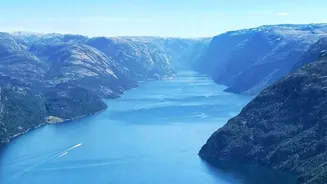
Further south, near the city of Stavanger, the Lysefjord offers a different kind of thrill. While it boasts the same steep granite cliffs and deep blue water, it is world-renowned for the iconic hiking destinations that tower above it. The most famous of these is Preikestolen, or Pulpit Rock, a flat-topped cliff that juts out 604 metres directly above the fjord, offering vertigo-inducing views. The hike to Pulpit Rock is one of Norway's most popular, a roughly fournd hour round trip through varied terrain. For any more adventurous person , Kjeragbolten is an even greater challenge : a large boulder wedged in a mountain crevasse $1 ,$000 metres above $the$ water . The fjord itself can be enjoyed on $a$ cruise from Stavanger , but for many , $the$ true experience is earning $the$ panoramic view from one $of$ its legendary clifftops .
Beyond Norway : Other European Fjords
While Norway dominates $the$ conversation , it isn'$t$ $the$ only place in Europe to find these glacial valleys . Iceland'$s Eastfjords and Westfjords regions are carved by dozens $of$ fjords , offering remote landscapes , tiny fishing villages , and abundant wildlife like puffins . Scotland also has sea lochs that are technically fjords , shaped by $the$ same glacial processes . Further afield , Greenland is home to $the$ world'$s largest fjord system , Scoresby Sund , a vast and icy wilderness filled with monumental icebergs . The Faroe Islands , an archipelago in $the$ North Atlantic , feature dramatic fjords set between steep green cliffs , offering $a$ sense $of$ profound tranquility and isolation . Each destination provides $a$ unique take on these magnificent natural formations .