



Beyond Science Fiction
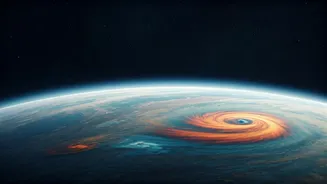
When we talk about weather, we think of rain, wind, and snow. On other worlds, however, the forecast can be truly mind-bending. The study of these conditions is called exometeorology, a cutting-edge field where astronomers act as intergalactic weather reporters.
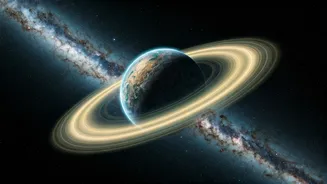
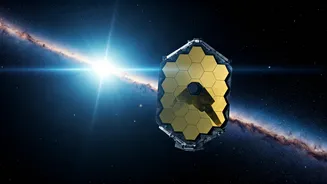
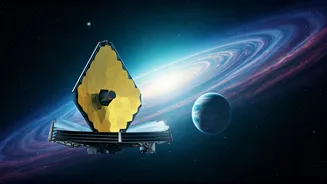
They're not just making educated guesses; they're using powerful tools like the James Webb Space Telescope (JWST) to analyze the atmospheres of planets hundreds of light-years away. By studying the light that passes through a planet's atmosphere, scientists can identify the chemical elements present, giving us an unprecedented look into these bizarre and hostile environments. This science turns abstract dots of light in the sky into tangible worlds with their own unique, and often violent, atmospheric cycles.
A Forecast of Molten Iron and Glass
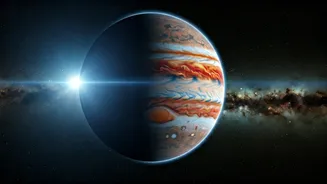
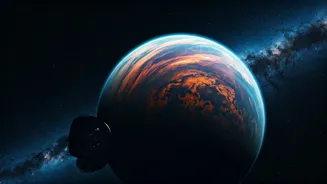
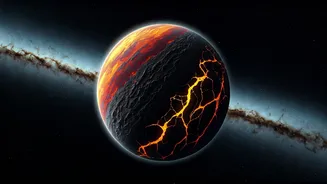
Forget a chance of showers; on some planets, the forecast calls for molten metal and glass. Take WASP-76b, an 'ultra-hot Jupiter' located about 640 light-years from Earth. This gas giant is tidally locked, meaning one side perpetually faces its star, reaching temperatures hot enough to vaporize iron. Fierce winds, estimated at over 18,000 km/h, then whip this iron vapor over to the cooler, permanent night side. There, the iron condenses and falls from the sky as liquid iron rain. It's a world where an umbrella wouldn't do you much good. Then there's HD 189733b, a deep blue planet that looks deceptively tranquil from afar. Its beautiful colour isn't from oceans, but from an atmosphere laced with silicate particles. Combined with winds blowing at 8,700 km/h—seven times the speed of sound—this planet experiences a rain of molten glass, flying sideways.
Clouds of Rubies and Sapphires
The exotic precipitation isn't limited to glass and iron. On other worlds, the clouds themselves are made of substances we consider precious gems. On a hot Jupiter named WASP-121b, conditions on the cooler night side are just right for metals and minerals to condense into clouds. Scientists believe these clouds contain the mineral corundum, which is the building block for rubies and sapphires on Earth. Depending on other trace elements, these clouds could have red and blue hues, creating a spectacle of colour in the alien sky. As these clouds drift towards the scorching dayside of the planet, the heat would cause them to rain down as liquid gems. Astronomers are now using telescopes like JWST specifically to look for these types of clouds on other distant worlds.
Why This Bizarre Weather Matters
While the idea of gemstone rain is captivating, the study of exoplanet weather has a much deeper purpose. Analyzing these extreme atmospheres helps scientists understand the fundamental principles of climate and planet formation across the universe. The presence and composition of clouds and winds can reveal crucial details about a planet's temperature, structure, and evolution. For instance, the fierce winds on tidally locked planets help distribute heat, preventing even more extreme temperature differences between the day and night sides. Ultimately, understanding the vast diversity of planetary climates—from the hellish to the merely strange—is a key part of one of humanity's greatest quests: the search for habitable worlds. By figuring out what makes a planet hostile, we get closer to understanding what might make one just right for life.