






The Problem with 'Imaginary' Numbers
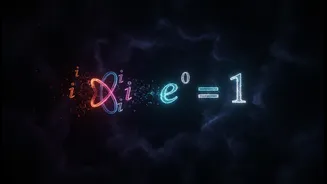
Quantum mechanics, the theory that governs the subatomic world, is built on equations that include complex numbers. These are numbers with two parts: a 'real' part we use for everyday counting and an 'imaginary' part, which is a multiple of the square
root of -1 (an impossible number in the physical world, often written as 'i'). For nearly a century, physicists have treated these complex numbers as a convenient mathematical tool, a calculator trick to make the physics of waves and probabilities work. But many were uncomfortable with the idea that a non-physical, 'imaginary' number was a fundamental ingredient of reality itself. This led to a long-standing question: could we rewrite the entire theory using only the real numbers we see in every other part of physics, from gravity to electromagnetism?
The Real-Number Alternative
The idea behind real-number quantum theory is to find a way to get the same results without ever using the number 'i'. It's a quest to simplify and, perhaps, find a more intuitive picture of the quantum world. Theorists argued that since all actual experiments produce real-number results—probabilities, energy levels, positions—the underlying theory should not have to rely on imaginary constructs. Over the years, physicists developed several versions of real-number quantum theory. These were often more cumbersome and less elegant than the standard complex-number version, but they showed that it was mathematically possible, in principle, to formulate the theory without 'i'. The challenge was whether this real-number version could perfectly describe every possible experiment.
Putting Reality to the Test
For a long time, this was just a philosophical debate. Recently, however, physicists devised clever experiments to force the issue. Inspired by the famous Bell tests that proved the non-local nature of quantum entanglement, theorists designed a scenario involving a quantum network with multiple sources of entangled particles. The key insight was that if quantum mechanics were based only on real numbers, there would be a strict upper limit on the level of correlation that could be observed between the particles in this specific setup. The standard, complex-number theory predicted a higher level of correlation. This created a clear, testable difference between the two theories. All that was left was to run the experiment.
The Verdict: Reality is Complex
In a series of landmark experiments, multiple independent teams built these quantum networks and measured the correlations. The results were decisive. The observed correlations easily broke the limit predicted by real-number quantum theory and perfectly matched the predictions of standard, complex-number quantum mechanics. The experiments effectively ruled out the simple versions of real-number quantum theory. This suggests that complex numbers are not just a mathematical convenience; they are a fundamental and indispensable feature of our universe's source code. The 'imaginary' number 'i' appears to be woven into the fabric of reality itself.
Why This Matters for the Future
While the debate has recently been reignited by new theoretical work suggesting a more complex real-number formulation could still work, the experimental verdict for now is strong. Confirming the necessity of complex numbers gives us greater confidence in the strange but powerful rules of quantum mechanics. For practical fields like quantum computing—a multi-billion dollar global race—this is crucial. Quantum computers derive their immense power from exploiting the full weirdness of quantum mechanics, including effects that depend on the interplay between the real and imaginary parts of quantum states. By confirming that the complex mathematical structure is physically necessary, these experiments solidify the foundations upon which future technologies are being built. It tells us we are on the right track, even if the path is paved with imaginary numbers.