


What Exactly Is This 'Planet Grid'?
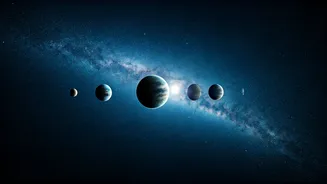
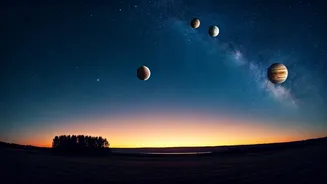
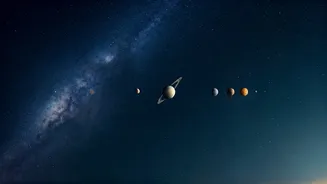
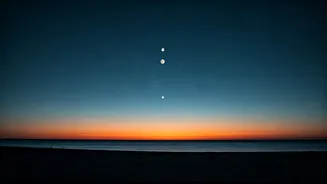
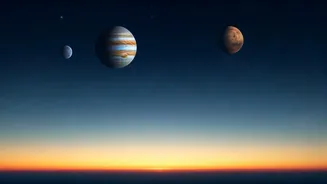
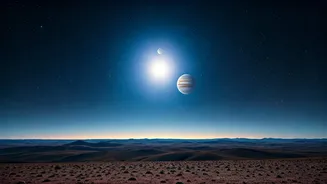
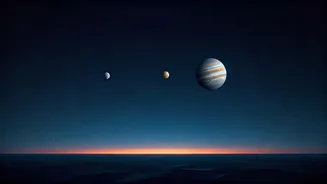
While the term 'grid' paints a vivid picture, what you're seeing tonight is technically a planetary conjunction or alignment. From our vantage point on Earth, Mercury, Venus, and Jupiter will appear to be very close to each other in a small patch of the sky.
They aren't actually close in space—they remain millions of kilometres apart on their own orbits around the Sun. This event is a beautiful line-of-sight illusion, a cosmic coincidence that offers a fantastic opportunity for stargazers. Such alignments involving multiple bright planets are not a once-in-a-lifetime event, but they are infrequent enough to be genuinely special. It's a chance to see three worlds, including the solar system's smallest and largest planets, in a single glance.
The Best Time and Direction to Look
Timing and direction are everything for this celestial show. The best viewing window will begin shortly after sunset. Aim to be in position about 30 to 45 minutes after the sun has completely dipped below the horizon. This is twilight, when the sky is dark enough to see the planets, but before they have set. You’ll need a clear, unobstructed view of the western sky. This is the direction where the sun sets, and it’s where the planetary trio will be visible. For viewers in India, this means looking towards the west-northwest. The planets will be relatively low on the horizon, so finding a spot away from tall buildings, trees, or hills is crucial for a good view. The entire spectacle will last for about an hour before the planets themselves begin to set.
How to Identify Each Planet
You won't need a star chart to tell these planets apart, as they have distinct characteristics. Here’s a simple guide: 1. **Venus:** This will be the easiest to spot. Venus is the brightest object in the sky after the Sun and Moon. It will appear as a brilliant, steady, silver-white light. You can't miss it. Because of its brightness, it will likely be the first of the three you see. 2. **Jupiter:** The second brightest of the trio will be Jupiter. It shines with a bright, steady, yellowish-white light. While not as dazzling as Venus, it will still stand out prominently against the fading twilight. It's the king of planets, and its regal glow is unmistakable. 3. **Mercury:** This is the trickiest one to find. Mercury is the faintest of the three and is always seen close to the sun's glare. It will appear as a small, star-like point of light, likely just above the horizon. Your best bet is to find the blazing Venus first, then scan the area nearby to locate Jupiter and the much dimmer Mercury. Having them all in one area makes spotting the elusive Mercury much easier than usual.
Do You Need a Telescope?
Absolutely not! This planetary alignment is a fantastic naked-eye event. The brightness of Venus and Jupiter makes them easily visible without any special equipment. In fact, one of the joys of this event is its accessibility to everyone. However, if you have a pair of binoculars, they will certainly enhance the view. Binoculars will make the faint Mercury pop more clearly and might even give you a glimpse of Jupiter’s four largest moons—Io, Europa, Ganymede, and Callisto—which will look like tiny pinpricks of light huddled close to the giant planet. A telescope would offer even more detail, like the phases of Venus, but it’s not necessary to simply enjoy the alignment itself.
Tips for the Best Viewing Experience
To make the most of this celestial event, a little preparation goes a long way. * **Escape the City Lights:** If possible, try to get away from the bright lights of the city centre. Light pollution washes out fainter objects like Mercury. A park, a rooftop, or even a balcony facing the right direction with minimal direct lighting will improve your view significantly. * **Let Your Eyes Adjust:** Give your eyes at least 10-15 minutes to adapt to the darkness. Avoid looking at your phone screen during this time, as its bright light will ruin your night vision. If you need a light, use a red torch, which is less disruptive. * **Use a Stargazing App:** If you're having trouble, a free stargazing app like Stellarium or SkyView can be a great help. Simply point your phone at the sky, and the app will identify the planets and constellations for you. It’s a great way to confirm what you’re seeing.