



A Crimson Cosmic Masterpiece
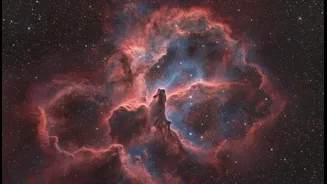
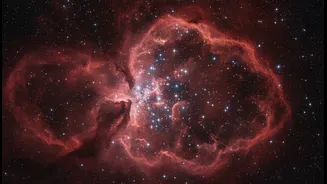
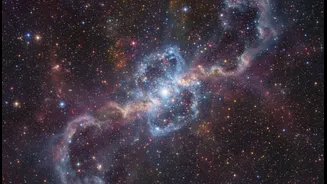
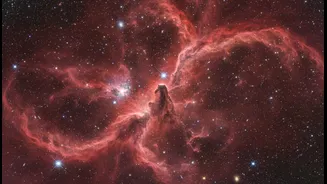
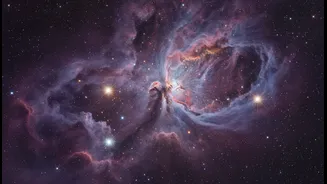
The star of the show is a vast region known as LH 95, located in the Large Magellanic Cloud, a small satellite galaxy orbiting our own Milky Way about 163,000 light-years away. Its nickname, the Crimson Nebula, comes from its striking appearance. The vibrant
red glow is not just for show; it is the tell-tale signature of heated hydrogen gas, a key ingredient for making stars. Powerful ultraviolet radiation from scorching young stars heats the surrounding gas, causing it to glow in a specific wavelength of red light called hydrogen-alpha. This allows astronomers to pinpoint exactly where the action is happening, making LH 95 an ideal laboratory for studying how stars come into being.
Inside the Stellar Nursery
Stars are born from massive, cold clouds of gas and dust that float through space. Gravity is the engine of creation, slowly pulling this material into denser and denser clumps. As a clump collapses, it begins to heat up, forming a protostar—a baby star not yet hot enough to ignite nuclear fusion. For millions of years, this protostar will continue to draw in material from a rotating disk of gas and dust surrounding it. When the core pressure and temperature reach a critical point—about 15 million Kelvin—nuclear fusion begins. At this moment, hydrogen atoms start fusing into helium, releasing an immense amount of energy and marking the official birth of a star.
Thousands of Stars in the Making
Hubble's detailed observations of LH 95 have given astronomers an unprecedented look at this process. They identified approximately 2,500 young stars that are still in the protostar phase, actively gathering mass from their dusty surroundings. These developing stars have nearly all the material they need but have not yet started nuclear fusion in their cores. Studying them has confirmed that as these 'pre-main-sequence' stars get older, the rate at which they pull in new material slows down. This helps scientists better understand the timeline of star formation and how long this crucial growth phase can last.
Cosmic Sculptors at Work
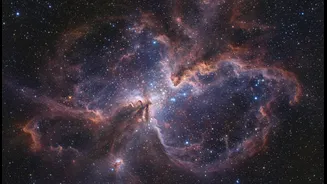
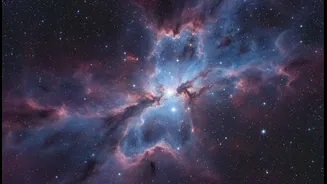
The most massive stars in LH 95 are true cosmic sculptors. These brilliant blue giants, some weighing more than three times the mass of our Sun, unleash powerful stellar winds and intense radiation. This energetic output carves out cavities and bubble-like structures within the crimson gas cloud. Meanwhile, denser ribbons of dust are more resistant to this erosion and stand out as dark, weaving filaments against the glowing background. This constant push and pull between the stars and the nebula creates the breathtakingly complex and dynamic landscape captured by Hubble.
A Story Written in Starlight
One of the most fascinating discoveries in LH 95 is that star formation hasn't happened all at once. Instead, it has occurred in waves over millions of years, with different generations of stars existing side-by-side. Researchers even identified one massive star that appears to be about a million years younger than most of its neighbors. This suggests that the formation of the first, larger stars may have triggered the birth of a second generation by compressing the surrounding gas. Being able to study these overlapping populations in a relatively clear and nearby region gives scientists a unique chance to reconstruct the history of star birth in extraordinary detail.