





Gaganyaan: India's Human Spaceflight Dream
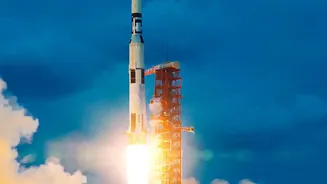
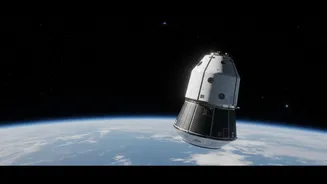
The Gaganyaan programme is one of India's most ambitious scientific undertakings, aiming to send a crew of three astronauts into a 400-kilometre Low Earth Orbit for a three-day mission and bring them back safely. A successful mission will make India only
the fourth country in the world—after the United States, Russia, and China—to possess independent human spaceflight capability. This national endeavour is not just about space exploration; it represents a significant leap in India's technological and strategic capabilities, cementing its position as a major player in the global space community. The entire programme is managed by the Indian Space Research Organisation (ISRO), with a methodical approach that prioritises safety above all else.
The Ultimate Insurance Policy: A Crew Escape System
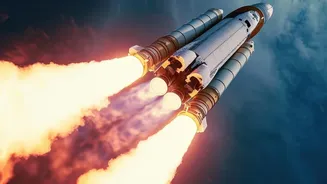
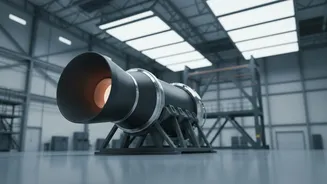
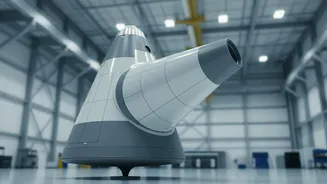
In the high-stakes world of rocket launches, things can go wrong in a fraction of a second. That's why every crewed spacecraft needs an 'eject' button. For Gaganyaan, this is the Crew Escape System (CES). It is an emergency measure designed to quickly pull the crew module, with the astronauts inside, to a safe distance from the launch vehicle in case of an emergency on the launch pad or during the ascent. Think of it as a powerful, fast-acting lifeboat for a rocket. This system uses a set of quick-firing solid motors to generate immense thrust, ensuring the crew is whisked away from any potential disaster. ISRO has conducted several tests, including a successful Pad Abort Test in 2018 and the Test Vehicle Abort Mission-1 (TV-D1) in October 2023, which validated the system at transonic speeds.
Simulating a High-Altitude Failure
The latest series of tests focuses on high-altitude aborts, simulating a failure when the rocket is already travelling at high speeds and altitudes. A mission, designated Test Vehicle Abort Mission-2 (TV-D2), is specifically planned to test an in-flight abort scenario at a higher altitude. These tests use a specially designed Test Vehicle—a single-stage liquid-fuelled rocket—to carry a boilerplate (unpressurised) version of the Gaganyaan Crew Module to a specific altitude and speed. At a predetermined point, an abort is deliberately triggered. The CES then fires its motors, separating the crew module from the rocket. The mission for TV-D2, for example, is planned to simulate an abort when the vehicle is travelling at supersonic speeds. This tests the system under more extreme aerodynamic stresses than previous lower-altitude tests.
A Symphony of Complex Systems
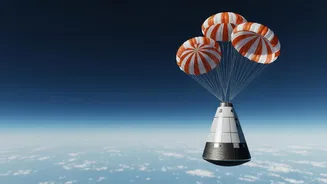
Successfully executing an abort manoeuvre is a complex sequence of automated events. Once the Crew Escape System pulls the module clear, the module must stabilise itself and begin its journey back to Earth. This involves jettisoning the escape system and deploying a series of parachutes to slow its descent. The Gaganyaan system uses a multi-stage parachute arrangement, including smaller drogue parachutes to stabilise the module at high speed, followed by large main parachutes to reduce the final velocity for a gentle splashdown in the ocean. The Crew Module is also designed with a system to upright itself if it lands inverted in the water, a feature tested in recent qualification trials. Every part of this sequence, from the explosive separation to the final splashdown, must work flawlessly.
The Road Ahead for Gaganyaan
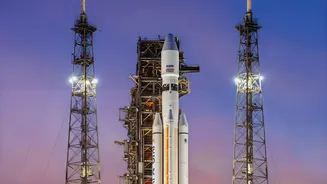
These abort tests are critical milestones on the path to the first crewed Gaganyaan flight, currently planned for 2027. Following the series of Test Vehicle abort missions, ISRO plans to conduct uncrewed orbital flights. The first uncrewed flight, G1, scheduled for late 2026, will send the full Gaganyaan spacecraft into orbit, carrying a humanoid robot named 'Vyommitra' to simulate human functions and test the life support systems. Data from these abort tests and uncrewed flights will provide the final confidence needed to certify the entire system as 'human-rated'. With each successful test, ISRO demonstrates its meticulous and safety-conscious approach, bringing India one step closer to achieving its historic goal of sending its own astronauts, or 'Gaganauts', into space.