



The Coming Encryption Apocalypse
For decades, our digital world—from bank transactions and government secrets to private messages—has been protected by encryption. These security measures are essentially complex mathematical puzzles that are too difficult for even the most powerful conventional
computers to solve in a reasonable timeframe. But that is about to change. The looming arrival of quantum computers threatens to render most current forms of encryption obsolete. These revolutionary machines, which operate on the strange principles of quantum mechanics, will have the power to solve those puzzles with alarming speed, creating what experts call a 'quantum apocalypse' for data security. Every piece of encrypted data, past and present, could one day be vulnerable.
Quantum's Unbreakable Promise
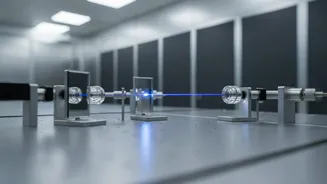
Fortunately, the same science that creates the threat also provides a solution: Quantum Key Distribution (QKD). Instead of relying on math, QKD uses the laws of physics to secure data. The process involves sending a secret key for encryption using individual particles of light, called photons. According to quantum physics, the very act of observing a photon inevitably disturbs it. This means if a third party tries to intercept the key, the particles are altered, and the attempt is immediately detected. The sender and receiver can then discard the compromised key and generate a new one. This makes the communication channel fundamentally secure, not by being hard to crack, but by being impossible to listen to in secret. It's considered 'future-proof' because no amount of future computing power can break a law of physics.
Taking Security to Orbit
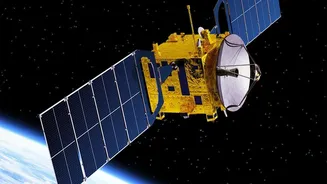
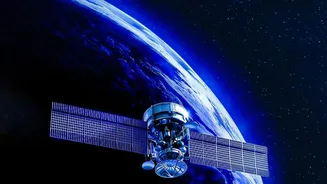
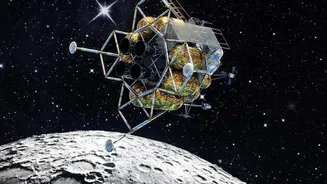
While QKD works well over fiber-optic cables on the ground, its range is limited. Signals degrade over distances greater than a couple hundred miles, making it difficult to create a truly global network. This is where satellites come in. By transmitting quantum keys from space, a single satellite can connect two distant points on Earth, bypassing the limitations of terrestrial fiber. This would enable ultra-secure communications across continents, a game-changer for military operations, critical infrastructure management, and international diplomacy. A global network of satellites equipped with QKD technology could form the backbone of a new, unhackable internet.
India's National Quantum Mission
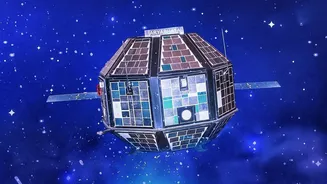
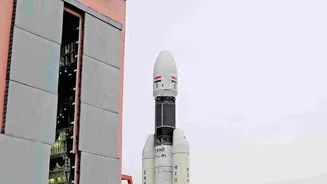
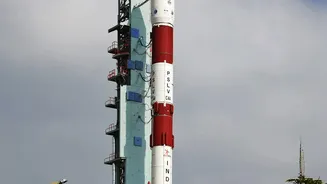
Recognizing the strategic importance of this technology, India has thrown its hat decisively into the ring. In 2023, the Indian government approved the National Quantum Mission (NQM), a comprehensive initiative backed by over $700 million. A key objective of the mission is to develop satellite-based secure quantum communication between ground stations within India and, eventually, with other countries, aiming for a range of over 2,000 kilometers. The Indian Space Research Organisation (ISRO) is at the forefront of this effort. ISRO has already successfully demonstrated free-space QKD over a distance of 300 meters, using it to conduct a video conference encrypted with a quantum key. This was a critical milestone, proving the viability of the core technologies and setting the stage for demonstrating the capability between ground stations and, ultimately, from a satellite.
A New Global Power Play
India's quantum ambitions are not happening in a vacuum. This is a story about geopolitics as much as it is about technology. For years, China has been seen as a leader in satellite-based quantum communication, having launched the world's first quantum satellite, Micius, back in 2016. India's accelerated push is a clear move to establish strategic parity and reduce reliance on foreign technology in a critical security domain. For the United States and its allies, India's emergence as a serious contender is a welcome development. It diversifies the field of players in a technology race that has largely been viewed as a two-horse contest between the U.S. and China. As nations realize that quantum leadership translates directly into geopolitical influence, India's progress could help shape a more multipolar quantum future.