

An Unexpected Cosmic Mystery
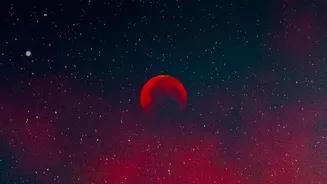
Since the James Webb Space Telescope (JWST) began sending back its breathtaking images, scientists have noticed a recurring anomaly: tiny, distinctively red specks of light. Dubbed 'Little Red Dots' (LRDs), these objects were unlike anything seen before.
Initial observations were perplexing. Their brightness suggested they were incredibly massive galaxies, but their existence so early in the universe's history—some appearing just 600 million years after the Big Bang—seemed impossible. According to established cosmological models, there simply wasn't enough time or material for such massive galaxies to form so quickly. This contradiction led some to wonder if our entire understanding of galaxy formation was broken.
Webb's Unprecedented Vision
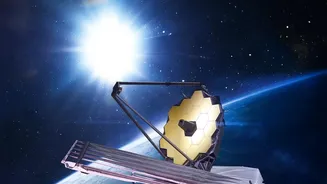
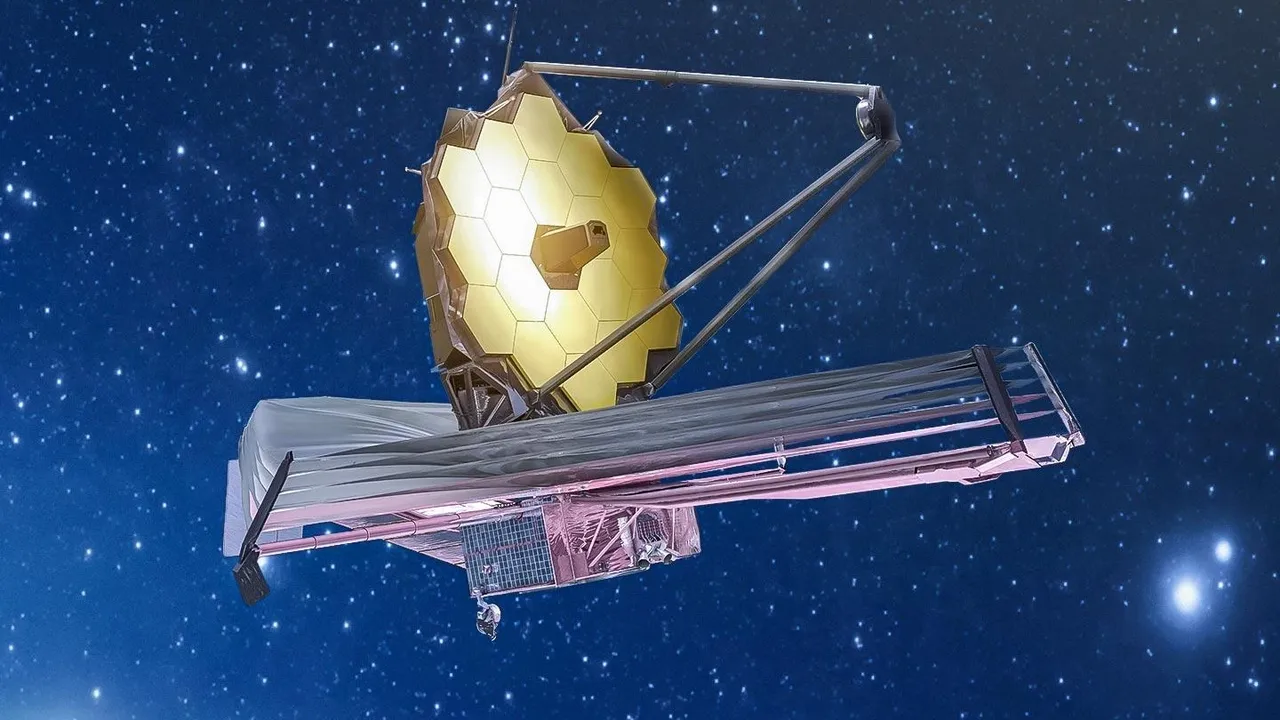
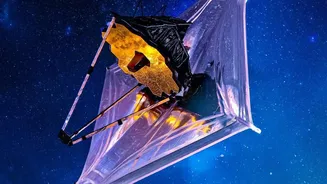
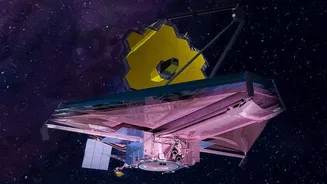
Solving this puzzle required the specific capabilities of the JWST. Unlike the Hubble Space Telescope, Webb is designed to see the universe in infrared light. This is crucial for two reasons. First, the light from the most distant objects is stretched to longer, redder wavelengths as the universe expands—a phenomenon called redshift. Second, infrared light can pierce through the thick clouds of cosmic dust that often shroud objects in the early universe. These capabilities allowed astronomers to gather detailed data, or spectra, from the LRDs for the first time. By analyzing how the light from these dots was composed, scientists could finally start to peel back the layers of the mystery.
The Black Hole Hypothesis
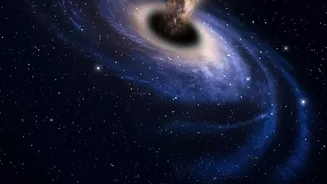
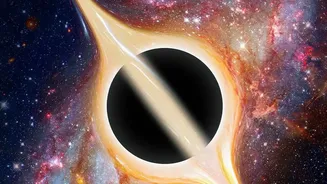
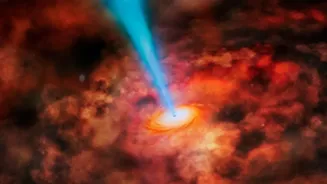
A leading theory, championed by researchers like Colby College's Dale Kocevski, suggests that LRDs are not 'universe-breaking' galaxies at all. Instead, their unusual brightness and color come from something else: a supermassive black hole at their center, actively feeding on gas and dust. This process, which creates what is known as an active galactic nucleus (AGN), generates an enormous amount of energy, making the object appear far brighter than its host galaxy's stars alone would. The theory posits that these are young, compact galaxies heavily obscured by dust, which reddens the light we see. When astronomers modelled the light from these objects, they found it was a perfect match for a combination of a small host galaxy and a voraciously growing black hole. In fact, for some LRDs, when the light from the black hole is subtracted, the host galaxy almost completely disappears, suggesting these could be a unique phase in galaxy evolution.
A New Phase of Cosmic Growth
Further research has reinforced the idea that LRDs are a temporary phase in the life of a galaxy. These objects appear in large numbers in the early universe but seem to vanish as the cosmos matures. Studies of slightly closer objects, like the 'Saguaro' galaxy, show a similar compact red core, suggesting it may be a more evolved version of an LRD. This indicates that the LRD phase might be a period of intense, dust-shrouded black hole growth that most galaxies go through. Some studies have even identified what might be a precursor to an LRD—a newborn, metal-poor starburst galaxy just beginning to form its central black hole. The discovery of an LRD that emits X-rays, unlike others, further suggests a transitional phase where the dense gas cocoon begins to clear.
Rewriting the Story of the Universe
The investigation into Little Red Dots is more than just solving a cosmic riddle; it's reshaping our understanding of the universe's dawn. These findings provide a new window into how the first supermassive black holes grew so large, so quickly—a long-standing problem in astronomy. They suggest an era of frantic, hidden growth that was previously invisible to us. By studying these objects, scientists can trace the evolution of galaxies from these compact, active phases into the sprawling structures we see in the universe today. The JWST's investment is paying off by not just discovering new objects, but by revealing entirely new processes that governed the birth of the cosmos.