






The Soul of the Village
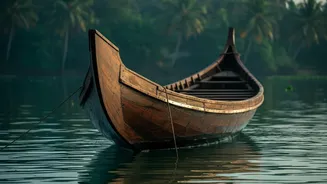
A Chundan Vallam, or snake boat, is far more than a racing vessel; it's the pride and soul of its village. Constructed from Anjili (wild jackfruit) wood according to ancient naval architecture principles, each boat is revered as a community deity. For
most of the year, it rests in a special shelter. As the racing season approaches, the entire village comes together to awaken it. This process begins not with tools, but with reverence. Traditionally, only men, walking barefoot, are allowed to touch the boat, a mark of deep respect for the craft that embodies their collective identity and honour. This sense of sacredness transforms the boat from mere wood into a living entity, readying it spiritually for the challenges ahead.
The Science of the Secret Sheen
The most critical ritual for achieving maximum velocity is the painstaking application of a special coating to the hull. This isn't just a simple polish; it's a traditional formula passed down through generations. The concoction typically consists of fish oil, carbon from burnt coconut shells, and raw eggs. While it sounds primitive, the science is remarkably sound. This organic mixture makes the hull's surface incredibly smooth and hydrophobic, or water-repellent. By creating this lubricious layer, the boat's friction against the water is drastically reduced. This minimises hydrodynamic drag, allowing the long, narrow vessel to glide through the backwaters with astonishing efficiency and speed, effectively turning ancient wisdom into a powerful performance enhancer.
Sealing and Strengthening
Before the oiling can begin, the boat undergoes a thorough inspection. A year of storage or the strains of previous races can leave small cracks or weaknesses in the wooden hull. The village carpenters, known as 'moothasharis', meticulously examine every inch. Any imperfections are repaired using traditional methods and materials that work in harmony with the boat's original construction. This repair work is crucial for ensuring the vessel is completely watertight and structurally sound. During a race, the long hull is subjected to immense stress from the rhythmic force of over a hundred oarsmen. These traditional repairs ensure the boat can flex and withstand this pressure without taking on water or, worse, breaking apart.
The Human Engine's Rhythm
The preparation is not limited to the wooden vessel alone; it extends to the human engine that powers it. The crew of rowers undergoes weeks of rigorous training, often living together in camps to build stamina and unity. Central to this is the 'Vanchipattu', or the boatman's song. Led by singers standing on the boat, these rhythmic chants are not just for morale. They act as a living metronome, synchronising the hundreds of oar strokes into a single, unified pulse. Even a split-second difference in timing can create drag and slow the boat down. The Vanchipattu ensures every ounce of human energy is converted into forward momentum, making the perfect harmony of the crew as crucial as the polish on the hull.