




A Planet on an Irregular Schedule
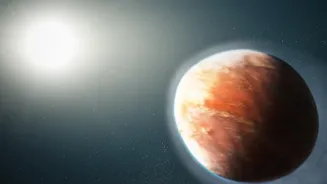
About 1,000 light-years from Earth, a giant planet known as TOI-2535 b was a regular subject of observation for NASA's Transiting Exoplanet Survey Satellite (TESS). This world, a type of planet called a 'hot Jupiter', is a gas giant that orbits its star
in a blistering 8.25 days. Astronomers detect such planets by watching for a tiny, periodic dip in a star's brightness as the planet passes, or 'transits', in front of it. For years, between 2019 and early 2026, TESS watched TOI-2535 b make its journey. But scientists noticed something strange: its timing was off. The planet would sometimes arrive up to six hours early for its transit, and other times six hours late, a sign that something was amiss in the system.
The Great Disappearance
The orbital quirks of TOI-2535 b were puzzling, but what happened in March 2026 was baffling. When astronomers pointed TESS at the star system, expecting to see the tell-tale dip in light, there was nothing. The planet had simply failed to show up. It was as if a world larger than Jupiter had vanished into the cosmic void. Observations confirmed that the transits, which had been getting shorter and shallower over time, had ceased entirely. This presented a major question: how does a planet just disappear? Planets don't simply evaporate, leading researchers to suspect a more complex dynamic was at play.
The Hidden Culprit Revealed
The solution to the mystery wasn't that the planet was gone, but that its orbit had been dramatically altered. New research, published in The Astrophysical Journal Letters, concluded that TOI-2535 b is not alone. It has a massive, unseen planetary neighbour. The powerful gravitational pull from this hidden companion is causing TOI-2535 b's orbit to wobble, much like a spinning top. This gravitational tug-of-war is so extreme that it has tilted the planet's orbit out of alignment with our line of sight from Earth. So, while the planet is still there, dutifully circling its star, it no longer passes in front of it from our perspective, making it invisible to the transit detection method.
A New Understanding of Planetary Dance
This discovery marks the first time astronomers have directly observed a planet's transits ceasing due to the pull of another planet. According to Samuel Yee, a UCLA astronomer involved in the study, it's the most extreme example of such a strong planetary interaction ever witnessed. The orbit is tilting so rapidly that the transit disappeared while scientists were actively watching it. This provides a fascinating realworld laboratory for understanding how planetary systems evolve. The 'wobble' in this system helps explain how 'hot Jupiters' like TOI_2535 b end up so close to their stars—a longstanding puzzle in planetary science. The orbital dance suggests it likely migrated inward slowly over time, influenced by its neighbour, rather than being violently thrown into its current position.