




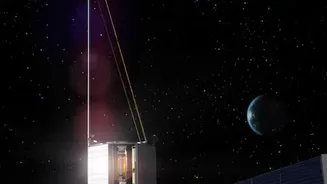
The Lure of an Ocean Moon
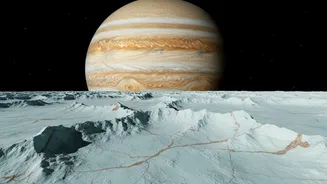
Jupiter's fourth-largest moon, Europa, is an enigmatic world, slightly smaller than Earth's own moon. From a distance, it appears as a smooth, bright ball crisscrossed with reddish-brown cracks. This unusually smooth surface suggests it is geologically
young, constantly being resurfaced. The reason, scientists believe, lies beneath its frozen crust: a vast, global ocean of liquid saltwater. Evidence strongly suggests this ocean may contain moreTwice the amount of water as all of Earth's oceans combined. What keeps this water from freezing solid so far from the Sun? The immense gravitational pull of Jupiter. As Europa follows its elliptical orbit, it is constantly stretched and squeezed by the gas giant's gravity. This process, called tidal flexing, generates enormous heat in the moon's interior, keeping the ocean liquid and potentially powering hydrothermal vents on the seafloor, similar to those found in Earth's deepest, darkest oceans where life thrives without sunlight.
Our Robotic Emissary's Long Voyage
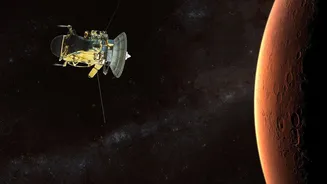
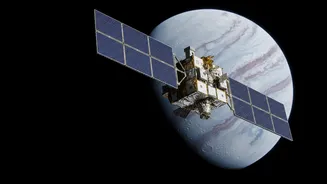
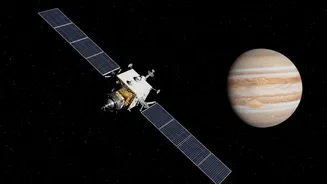
To investigate this tantalising world, NASA designed and launched the Europa Clipper, the largest interplanetary spacecraft the agency has ever built. Launched aboard a SpaceX Falcon Heavy rocket on October 14, 2024, the probe is now on a long and complex trajectory toward the outer solar system. Its journey spans 5.5 years and involves clever orbital mechanics to build up enough speed. The spacecraft already completed a crucial gravity-assist maneuver, swinging by Mars in March 2025. It is currently heading back toward our home planet for a final gravitational slingshot in December 2026 before beginning the long arc out to Jupiter. This extended path is necessary to get the massive craft all the way to its destination, where it is scheduled to arrive and enter into orbit around Jupiter in April 2030.
A Toolkit for Scientific Discovery
Europa Clipper is outfitted with a powerful suite of nine advanced science instruments, shielded within a heavy-duty radiation vault to protect them from Jupiter's harsh environment. This toolkit will work in concert to paint the most detailed picture of Europa ever assembled. Its instruments include high-resolution cameras (EIS) to map the icy surface in 3D and search for recent geologic activity. An ice-penetrating radar called REASON will probe the thickness of the icy shell, searching for the tell-tale signature of the liquid water ocean beneath. Spectrometers will analyze the chemical composition of the strange surface materials, while a thermal imager (E-THEMIS) will hunt for warm spots where the ocean might be close to the surface or even erupting in plumes. Finally, a magnetometer (ECM) will measure the moon's magnetic field to confirm the ocean's existence, estimate its depth, and even gauge its saltiness.
Searching for Ingredients, Not Life
It is crucial to understand that Europa Clipper is not a life-detection mission. It isn't carrying microscopes to look for alien microbes. Instead, its primary goal is to determine if Europa has the three key 'ingredients' for life as we know it: liquid water, essential chemical elements, and a source of energy. Scientists refer to this as determining the moon's 'habitability.' The mission will use its instruments to confirm the water is there, check for the presence of elements like carbon, hydrogen, nitrogen, oxygen, phosphorus, and sulfur, and investigate the energy provided by tidal heating. By assessing whether these conditions exist, Clipper will answer the fundamental question of whether Europa is a place where life could exist. This will pave the way for future missions that might one day drill through the ice and search for life itself.
An Elegant Dance of Flybys
Instead of orbiting Europa directly—which would expose it to a fatal dose of Jupiter's intense radiation—the Clipper spacecraft will enter a long, looping orbit around Jupiter itself. From the relative safety of this orbit, it will perform a carefully choreographed series of nearly 50 close flybys of Europa. During each pass, the spacecraft will dive in, swooping as low as 16 miles (25 kilometers) above the surface, gathering a wealth of data with all its instruments operating simultaneously before retreating to safety. This strategy allows the mission to survive for years, mapping different regions of the moon and building a global picture of its habitability. The first of these thrilling encounters is scheduled for the spring of 2031, marking the true beginning of the mission's scientific quest.