




A New Polygon on the Block
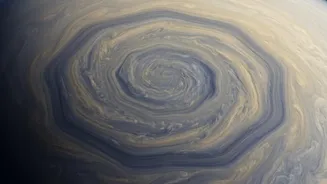
Scientists have discovered a massive, 10-sided atmospheric wave, or decagon, swirling in the clouds above Saturn's south pole. This new jet stream formation was spotted in images from the Hubble Space Telescope and confirmed by a team led by Agustín Sánchez-Lavega
of the University of the Basque Country. The discovery came as a surprise after decades of observing the planet. The Cassini spacecraft, which orbited Saturn from 2004 to 2017, saw no hint of such a long-lasting structure. It was only after Saturn's south pole, long hidden in shadow due to the planet's tilt, came back into Earth's view that the pattern emerged. Initial faint sightings by amateur astronomers in 2024 were followed by clearer observations, with archival Hubble data showing the feature began forming as early as 2023.
More Than Just a Northern Quirk
For over 40 years, one of Saturn’s most iconic features has been the giant, six-sided hexagon at its north pole. First seen by the Voyager probes in the 1980s, this stable structure has puzzled scientists, who wondered why such a perfect geometric shape would form naturally. Many believed it was a unique oddity. The discovery of a southern decagon changes everything. It suggests that the conditions in Saturn's atmosphere are ripe for creating such polygonal waves in both hemispheres. This finding shows that the famous hexagon is not as extraordinary as once thought, but rather one example of a phenomenon unique to Saturn among the planets in our solar system.
How Do These Shapes Form?
While the exact mechanisms are still being studied, scientists believe these geometric shapes are born from the planet's powerful jet streams. On a gas giant like Saturn, which lacks a solid surface with mountains or oceans to disrupt weather patterns, winds can flow in a more orderly fashion. Experiments in laboratories have shown that when a circular tank of fluid is rotated at different speeds, similar polygonal shapes can form in the turbulent area between the flows. These are essentially standing waves in the atmosphere. The number of sides—six in the north, ten in the south—likely depends on the specific speeds of the winds and other properties of the atmospheric layers at each pole.
A Tale of Two Polygons
The northern hexagon and southern decagon are not identical twins. The hexagon has been remarkably stable for at least four decades, remaining almost stationary. The new southern decagon, however, appears to be more dynamic and is slowly drifting eastward at about 10 kilometers per hour. Observations also suggest the southern wave is a vast, vertically layered structure embedded deep in Saturn's atmosphere, not just a pattern on the cloud tops. Scientists suspect a large storm or vortex may have triggered the wave's formation, and they are now watching in real-time to see if it will stabilize like its northern counterpart or eventually dissipate. Each of the decagon's ten sides already exceeds 16,700 kilometers in length—wider than the diameter of Earth.