

Meet Our New Cosmic Neighbour
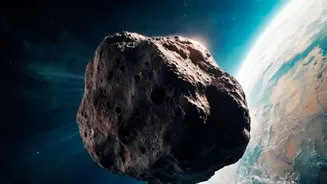
Astronomers have confirmed that a small asteroid is now temporarily orbiting our planet. First spotted in August 2026 by Hungarian astronomer Krisztián Sárneczky, the object was initially a mystery. After several weeks of observation to confirm it wasn't
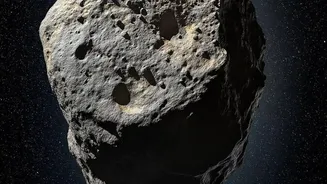
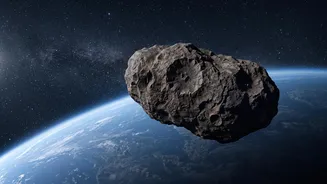
a piece of old satellite or space junk, the International Astronomical Union's Minor Planet Center gave it the official designation 2026 QQ8 in late October. This new companion is tiny, estimated to be only about 2 meters (or 6 feet) in diameter, which is roughly the size of a large appliance. Because of its small size and faintness, it's far too dim to be seen with the naked eye. It was pulled into Earth’s gravitational influence back in April and is now in a wide, looping orbit around us.
What Exactly Is a 'Mini-Moon'?
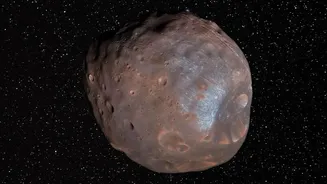
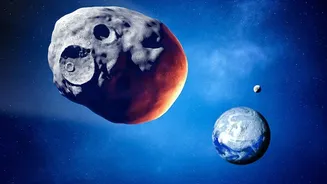
The term 'mini-moon' is an informal name for what astronomers call a Temporarily Captured Orbiter (TCO). These are asteroids that, while orbiting the Sun, happen to pass close enough to the Earth-Moon system at a slow enough speed to be snared by our planet's gravity. Instead of flying past, they are pulled into a temporary orbit around Earth. This capture is a delicate balancing act. The Sun's massive gravitational pull is always tugging on these objects, meaning their orbits around Earth are unstable and chaotic. Unlike our permanent Moon, which has been locked in a stable orbit for billions of years, mini-moons are just passing through. Their time with us is fleeting, typically lasting a few months to a few years before they escape back into an orbit around the Sun.
A Wobbly, Unstable Dance
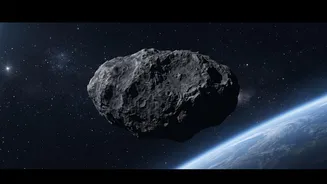
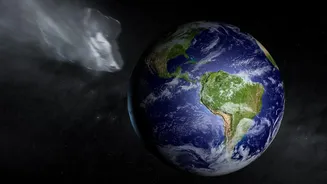
The orbit of 2026 QQ8 is nothing like the familiar, nearly circular path of our main Moon. Instead, it follows a complex and looping trajectory. This is due to the constant gravitational tug-of-war between the Earth, the Moon, and the Sun. This intricate dance will see the asteroid make several wide sweeps around our planet before it's flung back out into the solar system. Astronomers calculate that 2026 QQ8 will remain our cosmic companion until early December 2026. At that point, it will have gained enough speed to break free from Earth's gravitational hold and continue its solitary journey orbiting the Sun.
Is There Any Danger?
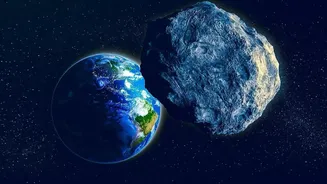
The short answer is no. Asteroid 2026 QQ8 poses absolutely no threat to Earth. Its orbit doesn't bring it dangerously close, and its tiny size means that even in the highly unlikely event of an atmospheric entry, it would burn up harmlessly. At best, it would create a bright meteor or fireball in the sky. The discovery and tracking of objects like 2026 QQ8 are a testament to the success of planetary defense programs like the Catalina Sky Survey, which discovered this object. These surveys constantly scan the skies for Near-Earth Objects (NEOs), helping scientists catalogue them, calculate their orbits, and monitor any potential risks to our planet.
Not Our First Temporary Friend
While the capture of a mini-moon is a fascinating event, it's not unprecedented. Astronomers believe that Earth likely has at least one such companion measuring about a meter across at any given time, though most are too small and faint to be detected. A few notable past visitors include 2006 RH120, a slightly larger asteroid that orbited Earth for about a year from 2006 to 2007. More recently, 2020 CD3 spent nearly three years as a mini-moon before departing in 2020. Each new discovery helps scientists better understand the population of small asteroids near Earth and the complex dynamics of how they interact with our planet.