







What Is This 'New' Star?
First, let's clear up the cosmic confusion. A 'brand-new' star isn't appearing out of thin air. Instead, a star that is usually too faint for us to see is about to have a dramatic, fleeting moment of glory. The celestial celebrity in question is T Coronae
Borealis (T CrB), also known as the 'Blaze Star.' Located about 3,000 light-years away, T CrB is what’s known as a recurrent nova. This means it's a star system that experiences dramatic outbursts, flaring to incredible brightness for a short period before fading back into obscurity. The last time anyone on Earth saw this happen was in 1946. Before that, it was 1866. Now, after nearly 80 years, it’s our turn.
The Science Behind the Outburst
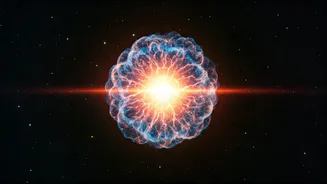
So what causes this stellar spectacle? T CrB isn't a single star but a binary pair locked in a gravitational dance. One partner is a red giant, a large, aging star that is puffing off its outer layers into space. Its companion is a white dwarf—the super-dense, collapsed core of a star that has already died. As they orbit each other, the immense gravity of the white dwarf pulls material (mostly hydrogen) from the red giant. This material builds up on the white dwarf's surface, like piling fuel onto a celestial fire. Over decades, the pressure and temperature of this stolen layer increase until it reaches a critical point, triggering a runaway thermonuclear explosion. This is the nova. The explosion doesn't destroy the star; it just blows the accumulated material off into space in a brilliant flash of light. Then, the whole cycle starts over again.
How and Where to See It
This is the exciting part. When T CrB erupts, it’s expected to reach a magnitude of +2, which is about as bright as Polaris, the North Star. This means it will be easily visible to the naked eye, even from areas with moderate light pollution, although a darker sky is always better. To find it, you need to locate the constellation Corona Borealis, or the 'Northern Crown'—a small, C-shaped arc of stars. It’s nestled between the constellations Boötes (home to the bright star Arcturus) and Hercules. Once you find the crown, the 'new' star will appear as an extra point of light within that familiar pattern. The eruption is predicted to happen anytime between now and September 2024. The peak brightness will only last for a few days, so the best advice is to get familiar with the Northern Crown now and start looking up every clear night. You might be the one to spot it first!
A Once-in-a-Generation Event
The 80-year cycle of T CrB makes seeing its eruption a truly special event. For most of us, it’s a one-shot opportunity. Think about it: the last time it flared, India was on the cusp of independence. The generation that witnessed it then is now passing the torch to us. There's a profound connection across time in watching the same cosmic clock tick. Unlike a solar eclipse that lasts minutes, or a meteor shower that is over in hours, this 'guest star' will linger in our sky for several days, a temporary beacon reminding us of the dynamic, ever-changing nature of the universe. It’s a shared global event that connects sky-gazers from all walks of life, united by the simple act of looking up in wonder.