




The Engine of Progress
The core concept that powers all long-term fitness gains is known as progressive overload. In simple terms, it means that to get stronger and fitter, you must continually increase the demands you place on your muscles. Your body is incredibly efficient;
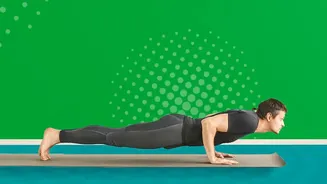
it adapts to the stress of exercise. If you do the same ten push-ups every day, eventually your body will master them, the exercise will become easy, and your progress will stall. This is a fitness plateau. To continue seeing changes, you must give your body a new, slightly harder challenge to overcome. This doesn't mean you need to attempt something dramatically different or dangerous. It’s about gradually turning up the difficulty on familiar movements.
Beyond Just Lifting Heavier
When people hear “progressive overload,” they often think it only means adding more weight to a barbell. While increasing resistance is a straightforward method, it’s just one of many tools in your arsenal. This is especially valuable for those who rely on bodyweight exercises or have limited equipment at home. True progress comes from manipulating different variables to make an exercise more demanding. You can increase repetitions, change the speed of your movement, reduce your rest time, or even make the exercise more complex. Let’s explore some of the most effective ways to apply this principle.
Method 1: Increase Volume
This is the most common starting point. Volume refers to the total amount of work you do, calculated as sets multiplied by reps. If you can comfortably do three sets of ten squats, your next goal could be to perform three sets of twelve. Once that becomes manageable, you might aim for three sets of fifteen, or add a fourth set. The key is to focus on maintaining good form. Adding sloppy repetitions doesn't build strength; it builds bad habits and increases the risk of injury. Aim for the last two reps of a set to feel challenging but achievable with proper technique.
Method 2: Increase Time Under Tension
Instead of focusing on how many reps you do, focus on how long your muscles are working during each one. This is called 'time under tension'. You can achieve this by adjusting your tempo. For example, during a squat, try taking a full three seconds to lower yourself down, pause for a second at the bottom, and then take one second to return to the start. This slow, controlled movement eliminates momentum and forces your muscles to work significantly harder through the entire range of motion, even with the same weight or just your bodyweight. Pausing at the most difficult part of an exercise is another powerful way to increase the challenge.
Method 3: Enhance Range of Motion
A simple way to make an exercise harder is to move your joints through a larger range of motion. For a push-up, this could mean placing your hands on elevated surfaces like yoga blocks or books, allowing your chest to go lower than your hands. This is called a deficit push-up. For a squat, it means working to go deeper while keeping your chest up and back straight. Working at the end range of motion, where muscles are often weakest, is a potent stimulus for strength and mobility gains.
Method 4: Decrease Rest Periods
If you normally rest for 90 seconds between sets, try cutting that down to 75 seconds, and then to 60. By reducing your rest time, you increase the metabolic stress on your body and challenge your cardiovascular system. Your muscles get less time to recover, forcing them to adapt to working in a fatigued state. This increases the overall density of your workout, making it more efficient and intense without adding a single rep or pound.
Method 5: Increase Complexity
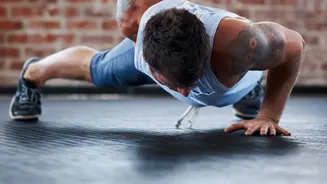
Once you have mastered a basic movement, you can progress by moving to a more complex variation. This often involves challenging your stability. A standard bodyweight squat can become a single-leg squat (or pistol squat). A standard push-up can evolve into an archer push-up (shifting your weight to one side) or a single-leg push-up. These advanced variations demand more from your core, improve your balance, and recruit smaller stabilising muscles, providing a whole new challenge without any external equipment.