






The Foundation: Why Your Tyres Matter Most
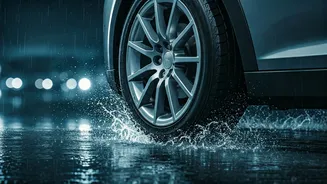
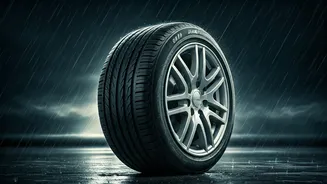
Your tyres are the only part of your vehicle in contact with the road, and their condition is paramount during the monsoon. Wet roads drastically reduce grip, and worn tyres significantly increase the risk of an accident. The biggest danger is hydroplaning,
which occurs when a layer of water builds up between your tyres and the road surface, causing a complete loss of steering and braking control. To prevent this, your tyres need to effectively channel water away, which is impossible without adequate tread depth. The legal minimum tread depth in India is 1.6mm, but for monsoon safety, experts recommend having at least 2-3mm. Worn-out tyres simply cannot disperse water effectively. Equally important is maintaining the correct tyre pressure as recommended by your car's manufacturer. Overinflation reduces the contact patch with the road, while underinflation affects stability and control. Before the rains set in, a thorough check of your tyres is not just advisable—it's essential.
The Unseen Enemy: Waterlogging and Potholes
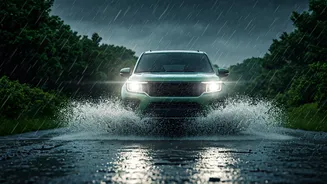
Indian cities are notorious for waterlogged streets and potholes that vanish under a sheet of muddy water. Driving through these hazards is a gamble. It's incredibly difficult to judge the depth of standing water, and it takes surprisingly little to cause serious problems. Just six inches of water can be enough to cause many cars to stall or lose control. A foot of water can float some vehicles, and two feet can carry away even SUVs and trucks. If water enters your engine's air intake, it can cause catastrophic and expensive damage. The safest rule is simple: if you can't see the road surface or if the water looks deep, do not drive through it. Turn around and find an alternate route, even if it takes longer. If you must traverse a puddle, do so slowly and steadily to avoid creating a wave that could flood the engine bay. After passing through water, gently tap your brakes a few times to help dry the brake components and ensure they are working effectively.
The Golden Rule: Time is Your Ally
The single most effective safety tool you have during the monsoon is time. Rushing on wet roads is a recipe for disaster. Braking distances can be two to three times longer on slick surfaces, and sudden manoeuvres can easily lead to a skid. Plan your journeys with the expectation of delays. Heavy rain inevitably slows traffic, sometimes to a complete standstill. Leaving earlier than you normally would removes the pressure to speed or take unnecessary risks. If the downpour becomes too heavy and visibility drops to a dangerous level, the smartest thing to do is pull over to a safe location—well off the main road—and wait for the weather to improve. Never use cruise control in the rain, as you need to be in complete control of your vehicle's speed and response at all times. Adopting a conservative driving style and simply slowing down is the most effective way to prevent skids and maintain control.
The Virtue of Patience: A Defensive Mindset
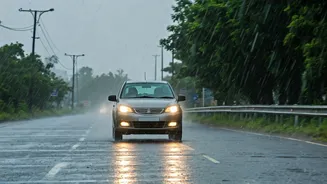
Patience behind the wheel is always important, but it becomes a critical safety skill during the monsoon. Visibility is reduced for everyone, not just you. Therefore, it's vital to increase your following distance to at least double what you would maintain in dry conditions. This gives you more time and space to react if the car ahead brakes suddenly. Be extra considerate of two-wheelers and pedestrians, who are more vulnerable and harder to spot in the rain. Avoid sudden acceleration, braking, or sharp turns. All inputs should be smooth and gentle to avoid unsettling the car's balance and breaking traction. Turn on your low-beam headlights, even during the day, to ensure other drivers can see you. Driving in the tracks of the vehicle ahead can also help, as its tyres will have displaced some of the standing water. Ultimately, a calm and defensive approach will get you to your destination more reliably than an aggressive one.
The Pre-Monsoon Vehicle Health Check
Beyond tyres, a few other components are crucial for rainy-season safety. Check your wiper blades; if they are cracked, hard, or leave streaks, replace them immediately. Clear vision is non-negotiable. Top up your windshield washer fluid with a proper cleaning solution, not just plain water, to help clear oily grime splashed from the road. Ensure your brakes are in perfect working order, as they have to work harder on wet surfaces. Test all your lights—headlights, taillights, brake lights, and indicators. In a downpour, being visible is just as important as being able to see. Finally, applying a protective wax polish to your car's paint and an anti-rust coating to the underbody can help prevent long-term damage from constant exposure to moisture.