


Beyond Webb: The Next Great Observatory
The James Webb Space Telescope (JWST) has been a spectacular success, revealing the early universe in breathtaking clarity. But science never stands still. Even as JWST makes new discoveries, NASA and its partners are deep into planning its successor:
the Habitable Worlds Observatory (HWO). Recommended by the National Academies as the top-priority large mission for the coming decades, HWO is a flagship space telescope with a revolutionary goal. Unlike its predecessors, it will be the first observatory specifically designed to directly image Earth-like planets around stars similar to our sun and scan their atmospheres for signs of life. While its launch is projected for the early 2040s, the groundwork being laid today marks the beginning of a new chapter in cosmic exploration.
What is the Habitable Worlds Observatory?
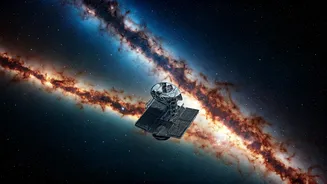
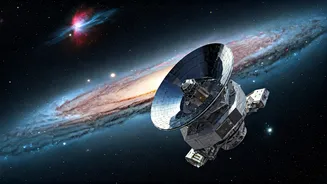
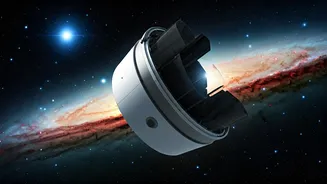
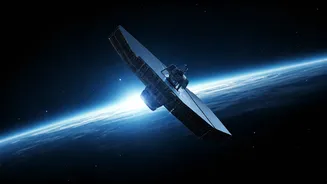
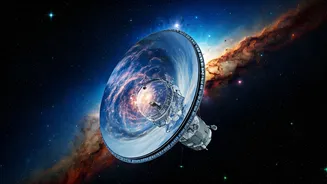
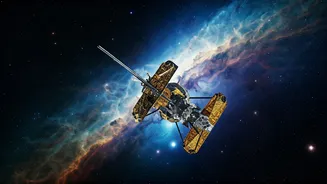
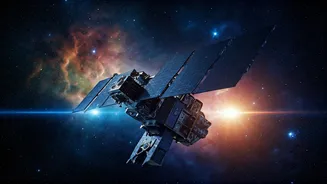
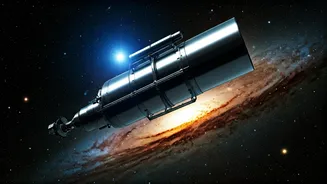
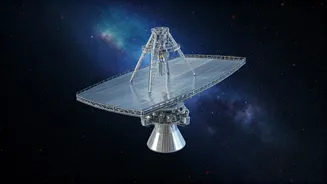
Think of the HWO as a 'super-Hubble'. It's a large space telescope concept that will operate in ultraviolet, visible, and infrared light, building on the technological legacies of Hubble, Webb, and the upcoming Nancy Grace Roman Space Telescope. The current concept features a primary mirror at least six meters in diameter, which will give it incredible sensitivity and resolution. One of its key mission objectives is to identify and survey at least 25 potentially habitable worlds. A key feature of the HWO's design is serviceability. Unlike JWST, which cannot be repaired, HWO will be designed for robotic servicing missions that can upgrade instruments and extend its operational life, securing its value for decades to come.
The Search for a Second Earth
The primary challenge in finding an Earth-like planet is that it is incredibly faint and easily lost in the overwhelming glare of its host star. To overcome this, HWO will employ an advanced coronagraph, an instrument designed to block starlight with unprecedented precision—thousands of times more capable than any previous version. This will allow the telescope to directly photograph rocky planets in the 'habitable zone,' the region around a star where liquid water could exist on a planet's surface. Once a candidate planet is imaged, HWO will use spectroscopy to analyze the light reflecting from its atmosphere. The goal is to detect chemical 'biosignatures'—gases like oxygen, methane, and water vapor—that could indicate the presence of life. While JWST can study the atmospheres of large gas giants, it isn't powerful enough to perform this kind of analysis on small, rocky, Earth-like planets.
A Monumental Technological Challenge
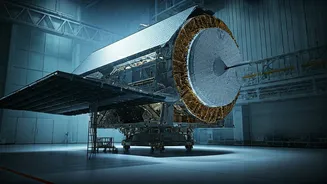
Building the HWO requires a significant leap in technology. To achieve the stability needed to find and image faint planets, the observatory's optical system must not move by more than the width of a single atom during observations. Its mirrors will need to be controlled with picometer precision—a scale smaller than an atom—to cancel out stray starlight that gets past the coronagraph. NASA is already selecting proposals from industry partners to develop these critical technologies, from ultra-stable structures to the highly advanced coronagraph itself. This mission will also benefit from its immediate predecessor, the Nancy Grace Roman Space Telescope, set to launch by May 2027. Roman will feature a technology-demonstrator coronagraph that will serve as a crucial stepping stone for the far more powerful instrument planned for HWO.
More Than Just Finding New Worlds
While the search for life is its headline-grabbing purpose, the Habitable Worlds Observatory will also be a transformative tool for all of astronomy. Its powerful instruments and large mirror will provide new insights into the evolution of galaxies, the life and death of stars, and the fundamental nature of the cosmos. It will be able to image deep fields four times faster than JWST, resolve individual stars in nearby galaxies, and even study objects in our own solar system with incredible detail. By combining a focused search for habitable planets with broad, powerful capabilities for general astrophysics, HWO is designed to revolutionize our understanding of the universe on multiple fronts.