








The Common Sense Fallacy
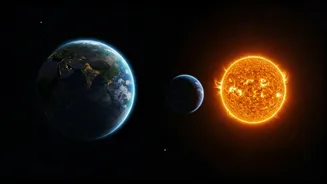
We all have a basic intuition about heat. Stand closer to a bonfire, and you feel warmer. Move away, and the chill sets in. It’s natural to apply this same logic to our planet and the Sun. Many people believe our seasons are a result of Earth’s changing
distance from the Sun as it follows its path through space. The idea is that we experience summer when we are nearest to the Sun and winter when we are farthest away. This explanation feels simple and correct, but it’s a deeply ingrained misconception. While Earth's orbit isn't a perfect circle, the variation in distance is not the primary driver of our seasons.
The Real Reason for the Seasons: A Tilt Story
The true cause of the seasons is far more elegant: the tilt of Earth’s axis. Our planet spins on an axis that is tilted at an angle of about 23.5 degrees relative to our orbital plane. This tilt remains constant as Earth journeys around the Sun. When the Northern Hemisphere is tilted toward the Sun, it receives more direct sunlight. Think of a flashlight shining directly onto a piece of paper; the light is concentrated and intense. This direct energy, coupled with longer days, heats the surface and brings summer. Conversely, when the Northern Hemisphere is tilted away from the Sun, the sunlight arrives at a shallower angle, spreading the same amount of energy over a larger area, making it less intense. This indirect sunlight and shorter days result in winter. The Southern Hemisphere experiences the opposite seasons at the same time.
So, What Is the Orbit Doing?
This doesn't mean Earth's orbit is a perfect circle. It's a slight ellipse. This means there are points in our year when we are indeed closer to or farther from the Sun. The point in our orbit where Earth is closest to the Sun is called perihelion, and the point where it is farthest is called aphelion. The difference in distance between these two points is about 5 million kilometers. While that sounds like a lot, it’s only a small fraction of our average distance from the Sun, which is about 150 million kilometers. This slight change in distance does have a minor effect on the amount of solar energy we receive—about a 7% variation—but its impact is vastly overshadowed by the effect of the axial tilt.
The Great Paradox: Closest During the Cold
Here is where our intuition truly gets scrambled. For those in the Northern Hemisphere, including India, the Earth reaches perihelion—its closest point to the Sun—in early January. That's right, we are closest to our star in the middle of winter. Meanwhile, Earth reaches aphelion, its farthest point, in early July, during the Northern Hemisphere's summer. This fact alone is powerful proof that distance is not the key factor for our seasons. The Northern Hemisphere is cold in January because it is tilted away from the Sun, and the less direct sunlight has a much greater cooling effect than the small gain in heat from being slightly closer.
It’s All About the Angle
Ultimately, the story of our seasons is a story of angles and duration, not proximity. The 23.5-degree tilt is the master conductor of our climate symphony. It dictates how directly the Sun's rays strike us and for how long each day, which in turn determines whether we are bundling up for winter or heading to the beach for summer. The slight eccentricity of our orbit is more of a background note, a subtle influence that can moderate or slightly intensify seasons but never defines them. For instance, the fact that the Southern Hemisphere's summer occurs near perihelion and its winter near aphelion makes its seasonal temperature swings slightly more extreme than in the north, but the tilt is still the main cause. In a fascinating twist, some data even suggests that the planet's average overall temperature is slightly cooler during perihelion in January, partly because the water-heavy Southern Hemisphere, which is tilted toward the sun at that time, absorbs heat more slowly than the land-heavy Northern Hemisphere does in July.