


The New Lunar Gold Rush
Water is the most valuable resource in space. It's essential for drinking and growing food, but it can also be split into hydrogen and oxygen. These components can provide breathable air for astronauts and, crucially, be used as rocket propellant. Finding
a local source of water on the Moon would revolutionize space exploration, making long-term human settlements and missions to Mars more feasible and affordable. Instead of hauling massive quantities of water from Earth, future explorers could 'live off the land'. This concept, known as In-Situ Resource Utilization (ISRU), is the driving force behind the renewed global interest in the Moon, and India’s Chandrayaan programme has played a pivotal role in confirming its potential.
Why the South Pole is a Hotspot
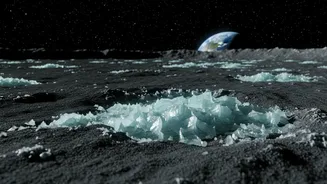
The Moon's south pole is a land of extreme contrasts. While some peaks are bathed in near-perpetual sunlight, the floors of many deep craters have not seen the sun for billions of years. These 'Permanently Shadowed Regions' (PSRs) are among the coldest places in the solar system, with temperatures plunging as low as -248°C. Scientists have long theorized that these frigid craters act as 'cold traps', preserving water ice delivered by comets and asteroids over eons. Data from past missions, including India's Chandrayaan-1 and Chandrayaan-2, have provided strong evidence of this ice, not just on the surface but potentially in much larger quantities mixed into the lunar soil, or regolith, a few meters down.
ISRO's Ambitious Toolkit: The LUPEX Mission
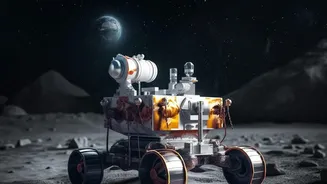
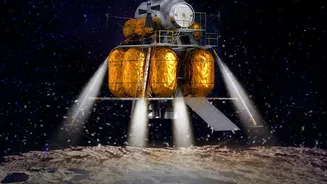
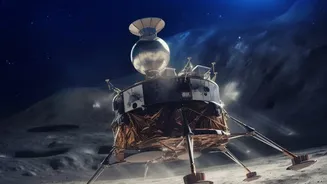
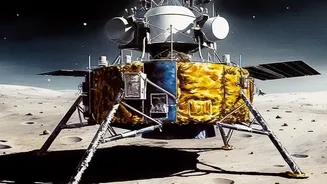
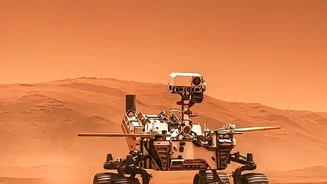
The headline mission for this task is the Lunar Polar Exploration Mission (LUPEX), a joint venture between ISRO and the Japan Aerospace Exploration Agency (JAXA). Scheduled for no earlier than 2028, this mission is a significant step up in complexity. ISRO is responsible for developing the lander, which will safely touch down in the challenging south polar terrain. JAXA will provide the H3 launch vehicle and a sophisticated, 350 kg rover. This international collaboration, which also includes instruments from NASA and the European Space Agency (ESA), will pool global expertise to tackle the formidable challenge of lunar resource prospecting. The LUPEX mission will follow India's Chandrayaan-4, which is a separate sample-return mission planned for around 2027.
Drilling for Cosmic Treasure
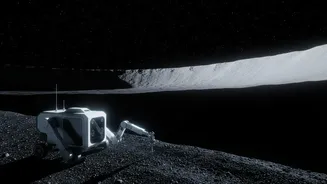
The 'payloads' aiming to extract this ice are a suite of advanced instruments aboard the LUPEX rover. The key piece of equipment will be a drill capable of boring up to 1.5 meters beneath the lunar surface to collect subsurface samples. This is crucial because studies suggest the amount of ice below the surface could be five to eight times greater than what's on top. Once the sample is collected, a suite of onboard analyzers, including the REsource Investigation Water Analyzer (REIWA), will heat the regolith. This process will release any volatile compounds, like water, which can then be measured to determine their quantity and quality. One NASA-provided instrument, the Neutron Spectrometer System (NSS), will help hunt for hydrogen concentrations—a key indicator of water—even before drilling begins.
The Challenges of Mining in Shadow
Extracting resources in a PSR is no simple task. The extreme cold can seize up mechanical parts, and the complete darkness poses a major operational hurdle. Since solar panels won't work in the shadows, the rover will need robust power and thermal management systems to survive and operate for its mission duration of over three months. Navigating the treacherous, cratered terrain in darkness to find the best spots for drilling will require precise planning and real-time decision-making. The LUPEX mission is designed not just to find water, but to test the very technologies—like surface mobility, excavation, and night-time survival—that will be necessary for building a sustainable human presence on the Moon.