




A Messenger From Another Star
Spotted for the first time on July 1, 2025, by the ATLAS survey in Chile, the object immediately stood out. Its path was all wrong for something belonging to our solar system. Instead of a gentle, looping orbit around the Sun, it was screaming through
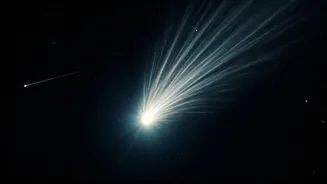
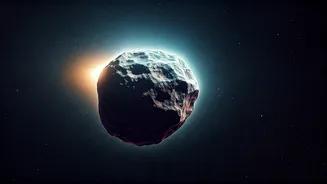
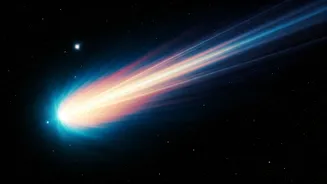
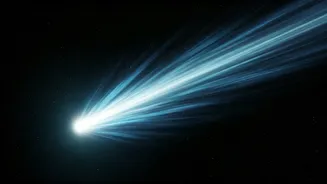
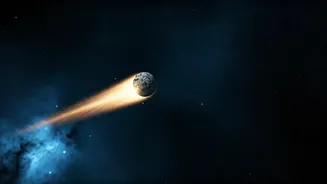
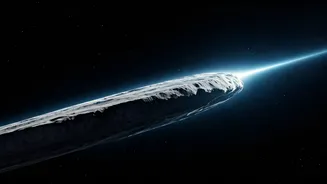
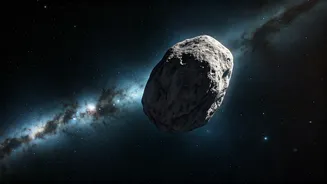
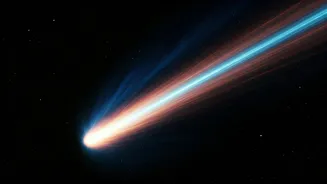
space on a hyperbolic trajectory, moving too fast to be captured by the Sun's gravity. This confirmed its extraordinary origin: interstellar space. The object was officially designated 3I/ATLAS, signifying it as the third interstellar object ever detected, following the enigmatic 'Oumuamua in 2017 and Comet 2I/Borisov in 2019. Unlike 'Oumuamua, which was a mysterious, inert rock, 3I/ATLAS behaved like a classic comet, developing a fuzzy cloud of gas and dust—a coma—as it was warmed by our Sun.
The Ultimate Cosmic Time Capsule
Comets from our own solar system are often called time capsules because they are pristine leftovers from its formation 4.6 billion years ago. But 3I/ATLAS is a time capsule of a different order entirely. It is a frozen relic from the birth of another, unknown star system. Early analysis of its trajectory suggests it may have originated from the Milky Way's 'thick disk,' a region populated by ancient stars. This has led to the incredible possibility that 3I/ATLAS could be profoundly old—perhaps as old as 7 or even 10 billion years—making it potentially older than our own Sun and Earth. If true, this interstellar visitor carries a chemical snapshot of a much earlier era of our galaxy, offering a direct sample of the raw materials that built worlds long before our own.
Decoding An Extrastellar Message
While we couldn't send a probe to visit the fast-moving comet, an arsenal of our most powerful telescopes was aimed in its direction as it passed through our system in late 2025. The Hubble and James Webb Space Telescopes (JWST), along with observatories on Earth and even spacecraft orbiting Mars, scrambled to analyze the light coming from its gassy coma. This technique, called spectroscopy, acts like a cosmic barcode scanner, revealing the comet’s chemical composition. Scientists detected familiar compounds like cyanide and water, but also intriguing clues about its origins. JWST observations, for instance, found unusually high levels of deuterium (a heavy form of hydrogen), suggesting the comet formed in an extremely cold environment, far from its parent star. Each element and molecule tells a piece of the story about the conditions in its home system.
A Fleeting, One-Time Visit
The window to study 3I/ATLAS was brief. After its discovery, it swung toward the Sun, making its closest approach on October 29, 2025, at a point just outside the orbit of Mars. It then swept past Earth in December 2025 at a safe distance of about 270 million kilometers before beginning its long journey back out of the solar system. Now, having passed the orbit of Jupiter, it is receding back into the interstellar void, never to return. This fleeting visit highlights the precious and random nature of these encounters. We are, in effect, relying on the galaxy to send us samples from its countless other stellar nurseries. While we can’t chase them down, each pass gives us a new data point to understand our own place in the cosmos.