
A Star's Ghostly Remains
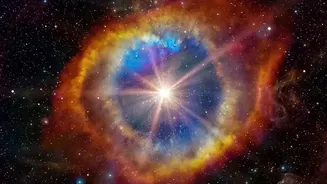
The Helix Nebula is what astronomers call a planetary nebula. The name is a historical misnomer from the 18th century, when these objects looked like fuzzy, planet-like discs through early telescopes. In reality, they have nothing to do with planets.
Instead, a planetary nebula is the elaborate, glowing shell of gas and dust ejected by a dying star. Located about 650 light-years from Earth, the Helix Nebula is one of the closest and most striking examples of this cosmic phenomenon. It’s the aftermath of a star, once similar to our own sun, that reached the end of its life, shedding its outer layers into space. At its center is a tiny, incredibly hot and dense stellar core called a white dwarf, which illuminates the expanding gas, causing it to fluoresce.
The Life and Death of a Sun-Like Star
To understand how a planetary nebula forms, you have to know how a star like our sun lives and dies. For about 90% of its life—a period of roughly 10 billion years—the sun fuses hydrogen into helium in its core. This process generates the energy that keeps it stable. But eventually, the hydrogen fuel will run out. In about five billion years, our sun will begin to fuse helium, causing it to swell dramatically into a red giant, likely engulfing the inner planets. This phase is unstable. The star will convulse, puffing off its outer layers of gas into space. The core that's left behind will collapse under its own gravity into a super-dense white dwarf, about the size of Earth but containing roughly half the star's original mass. The intense ultraviolet radiation from this hot white dwarf will then ionize and light up the expelled gas, creating a spectacular, short-lived planetary nebula.
What Webb's Powerful Gaze Reveals
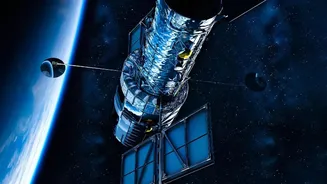
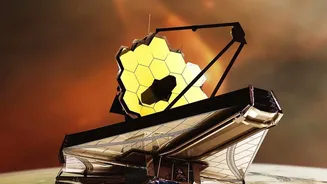
While we've studied the Helix Nebula for centuries, the James Webb Space Telescope (JWST) has provided an unprecedentedly clear infrared view, revealing astonishing new details. Webb’s images highlight thousands of previously unseen structures called “cometary knots.” These are not actual comets, but massive, tadpole-shaped globules of gas and dust. Each knot's head can be twice the size of our solar system, with tails stretching for 100 billion miles. These knots are thought to form as hot, fast-moving gas recently ejected by the central star crashes into cooler, denser gas that was shed thousands of years earlier. Webb’s NIRCam (Near-Infrared Camera) captures the intricate filaments and the stark transition from hot, ionized gas near the star to the cooler molecular gas further out, allowing scientists to study how this stellar material is recycled back into the galaxy.
So, Is This Our Sun's Future?
In a word: yes. The process that created the Helix Nebula is the widely accepted fate for stars in our sun's mass range. In about five billion years, after its red giant phase, the sun will puff away its atmosphere to form its own planetary nebula, leaving a white dwarf at its core. It will return its constituent elements back into the interstellar medium, providing the raw materials for a new generation of stars and planets. Will it look identical to the Helix Nebula? Not necessarily. The exact shape and structure of a planetary nebula can be influenced by factors like the star's rotation, magnetic fields, and whether it has a companion star. However, the fundamental spectacle—a dying star’s final, beautiful act of shedding its layers to be illuminated by its fading core—is a direct preview of our solar system’s ultimate destiny. Looking at the Helix Nebula is like looking into our own cosmic future.