




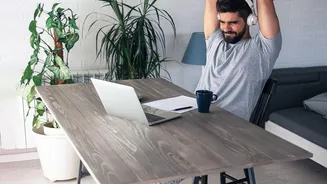

1. Upper Trap and Neck Stretch
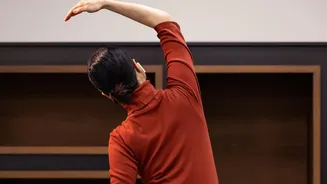
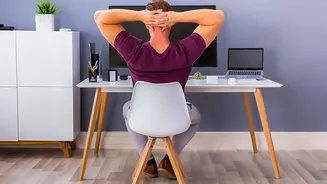
The muscles connecting your neck and shoulders, known as the upper trapezius, often hold tension from hunching over a screen. This causes that familiar knotty feeling. To release it, sit tall in your chair with your feet flat on the floor. Gently tilt
your right ear toward your right shoulder without forcing it. To deepen the stretch, you can place your right hand on the side of your head and apply very light pressure. Hold this for 15 to 30 seconds, feeling a gentle pull along the left side of your neck, then slowly return to the center and repeat on the other side. This helps improve neck mobility and eases stiffness.
2. Seated Spinal Twist
Prolonged sitting can make your mid-back (thoracic spine) rigid, forcing your lower back and neck to compensate. A seated twist helps restore mobility. Sit upright in your chair with both feet flat on the floor. Keeping your hips square, gently twist your upper body to the right, using the armrest or back of the chair for a light assist. Exhale as you deepen the rotation, looking over your right shoulder. Hold for 15-20 seconds, breathing normally. You should feel a stretch through your mid-back. Slowly unwind and repeat on the left side.
3. Chest Opener and Shoulder Squeeze
We spend much of the day leaning forward, which shortens our chest muscles and rounds our shoulders. This 'chest opener' stretch counteracts that posture. Sit at the edge of your chair and clasp your hands behind your back. If that's difficult, simply grip the sides of your chair. Now, straighten your arms, roll your shoulders back, and squeeze your shoulder blades together as if holding a pencil between them. You should feel a stretch across the front of your chest. Hold for 15-20 seconds, then release. This strengthens the muscles between your shoulders and promotes better posture.
4. Seated Figure-Four Stretch
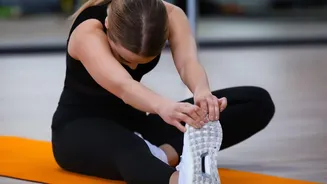
Sitting shortens the hip muscles and can lead to tightness in your glutes and piriformis, which sometimes contributes to lower back discomfort. The figure-four stretch is an excellent hip opener. While seated, cross your right ankle over your left knee. Keep your right foot flexed to protect the knee joint. Sit tall, and if you want a deeper stretch, gently hinge forward from your hips while keeping your back straight. You'll feel this in your right glute and outer hip. Hold for 20-30 seconds, then switch legs.
5. Seated Cat-Cow
This classic yoga pose, adapted for your chair, brings gentle movement to your entire spine, relieving tension from your neck to your lower back. Place your hands on your knees with your feet flat on the floor. On an inhale (the 'Cow' pose), arch your back, lift your chest, and look slightly toward the ceiling. On an exhale (the 'Cat' pose), round your spine, drop your chin to your chest, and let your shoulders roll forward. Flow between these two positions for 8-10 repetitions, coordinating the movement with your breath.
6. Wrist and Forearm Stretch
Constant typing can fatigue the muscles in your forearms that control your fingers and wrists. To stretch them, extend your right arm forward with the palm facing down. Use your left hand to gently bend your right wrist downward, pulling the fingers toward your body until you feel a stretch on the top of your forearm. Hold for 15-20 seconds. Then, flip your hand so the palm faces up and gently pull your fingers down toward the floor to stretch the underside of your forearm. Repeat on both sides to release tension.
7. Standing Hip Flexor Stretch
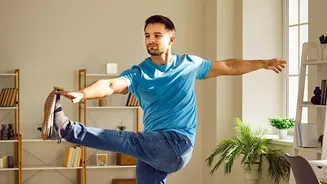
Your hip flexors, the muscles at the front of your hips, become chronically shortened from sitting, which can pull on your lower back. Taking a moment to stand up for this stretch is key. Stand beside your desk for balance. Step your left foot back into a lunge position. Gently bend your front knee and shift your weight forward until you feel a stretch in the front of your left hip. For a deeper stretch, squeeze the glute of your back leg. Hold for 20-30 seconds without arching your lower back, then switch sides.