


The Power of a Sustained Hold
When you hold a yoga pose, you engage in something called an isometric contraction. This means your muscles are under tension, but they aren't changing in length. Think of it as active stillness. Unlike dynamic exercises that focus on movement, holding
a pose challenges your muscular endurance and builds foundational stability. This method is particularly effective for strengthening the deep core muscles, including the transverse abdominis, which wraps around your torso like a natural corset, and the muscles supporting your spine. By consistently practicing these static holds, you train your core to provide constant support, improving your posture and making all your movements, both in yoga and in daily life, feel more integrated and effortless. It’s a shift from chasing a superficial 'six-pack' to cultivating a truly strong and stable centre.
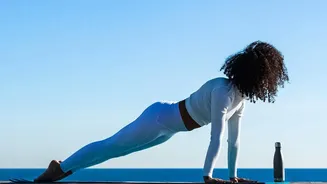
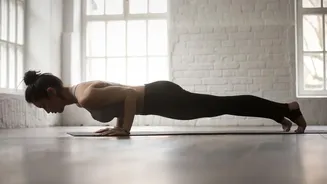
Plank Pose (Phalakasana)
Plank is the quintessential core-strengthening pose for a reason: it engages your entire body. To practice it correctly, start on your hands and knees, then step your feet back until your body forms a straight line from your head to your heels. Your hands should be directly under your shoulders. Actively press the floor away and avoid letting your hips sag or rise too high. The key to unlocking its core benefits is to draw your belly button in towards your spine, engaging your abdominals. Imagine you are bracing your midsection. Breathe steadily and hold for 20 to 30 seconds to start, gradually increasing the time as you build strength. For a gentler variation, you can lower your knees to the mat while keeping your core engaged.
Bird-Dog Pose (Dandayamana Bharmanasana)
This pose is a fantastic exercise for building stability because it challenges your balance. Start on all fours with a neutral spine. On an inhale, extend your right arm straight forward and your left leg straight back, keeping both parallel to the floor. The crucial part is to keep your torso completely still; do not let your hips tilt or your lower back arch. This requires your abdominal and back muscles to work together to stabilize your spine as your limbs move. Hold for a few breaths, then exhale as you return to the starting position with control. Repeat on the other side, extending your left arm and right leg. This pose trains your core for coordination and control, which is essential for functional strength.
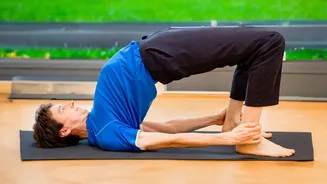
Bridge Pose (Setu Bandhasana)
Bridge Pose strengthens the entire back side of your body, including your glutes and hamstrings, which are a vital part of your core support system. Lie on your back with your knees bent and feet flat on the floor, hip-width apart. Your arms should rest alongside your body. Press into your feet and lift your hips off the floor. The mistake many people make is arching their lower back too much. Instead, focus on engaging your glutes and hamstrings to drive the lift. Keep your core tight to prevent your ribs from flaring out, ensuring the work stays in your posterior chain and not your lower back. Hold at the top for several deep breaths before slowly lowering one vertebra at a time.
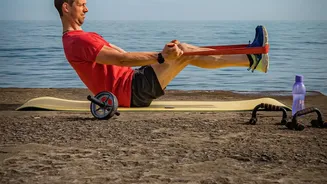
Boat Pose (Navasana)
Boat Pose is a direct and powerful challenge to your abdominal muscles. Sit on the floor with your knees bent and feet flat. Lean back slightly, keeping your spine straight, and lift your feet off the floor until your shins are parallel to the ground. This bent-knee version is a perfect starting point for building strength. Your body will form a 'V' shape. The most important alignment cue is to keep your chest lifted and open; avoid rounding your back, which puts strain on it. You can keep your hands behind your knees for support or extend your arms forward, parallel to the floor, for a greater challenge. You will feel the muscles in your midsection firing up to hold you in place. Hold for 15-20 seconds, focusing on steady breathing.