





Nature's Tiniest Alchemists
In the ongoing search for solutions to environmental contamination, scientists are looking to some of the unlikeliest of heroes: bacteria. For decades, researchers have been intrigued by microbes that thrive in environments contaminated with heavy metals
and radioactive materials. Among the most studied are species from the genus Geobacter, which are commonly found in soils and sediments all over the world. These microorganisms are not just surviving in the presence of uranium; they are actively using it as part of their metabolic processes. This discovery has opened a new frontier in bioremediation, the use of living organisms to clean up pollutants. Instead of costly and invasive chemical treatments, we might one day deploy armies of bacteria to tackle some of our most stubborn toxic legacies.
How Bacteria Neutralize Uranium
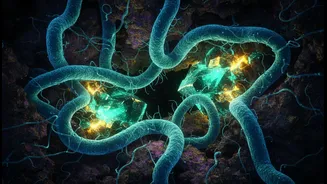
The secret to these bacteria's abilities lies in a process similar to how we breathe oxygen. Many of these microbes are anaerobic, meaning they live in oxygen-free environments. Instead of breathing oxygen, they 'breathe' metals. When they encounter uranium dissolved in groundwater, they transfer electrons to it. This simple act of chemistry is transformative. Soluble uranium, which is in a form known as uranium(VI), can travel easily through water, spreading contamination far and wide. The bacterial interaction converts it into insoluble uranium(IV). This solid form, a mineral called uraninite, is far less mobile and toxic. Essentially, the bacteria lock the uranium in place, preventing it from polluting larger areas and making it easier to manage. Researchers have identified several mechanisms for this, including using tiny protein filaments that act like wires to 'zap' the uranium and using molecules on their cell surfaces that act like sponges to soak it up.
The Promise of Bioremediation
The potential applications are enormous, particularly for cleaning up sites contaminated by decades of mining and nuclear materials production. Conventional cleanup methods for uranium-contaminated groundwater are often expensive and can be ineffective, especially at low concentrations. Bioremediation offers a more sustainable and less invasive alternative. Scientists envision creating 'bio-barriers' in the ground, where communities of these bacteria are stimulated to grow. As contaminated groundwater flows through this zone, the microbes would strip out the uranium, effectively creating a natural filtration system. Recent research has even shown that providing the bacteria with a simple food source, like glycerol, can dramatically enhance their ability to convert dissolved uranium into a remarkably stable, solid compound, further boosting the potential for long-term remediation.
From the Lab to the Land
Despite the promise, transitioning this technology from controlled laboratory settings to the complexities of a real-world contaminated site presents significant challenges. The effectiveness of these bacteria can be influenced by various environmental factors like pH, temperature, and the presence of other chemicals like nitrate. Researchers are working to understand how to create the ideal conditions to encourage these helpful microbes to thrive. In some cases, this might involve 'biostimulation', where nutrients are added to the ground to energize the existing native bacteria. In other cases, 'bioaugmentation', or the introduction of specific, highly effective bacterial strains, might be necessary. While no full-scale remediation of a former mining site has yet returned an aquifer to its original pristine condition, bioremediation remains one of the most promising strategies being developed to tackle this persistent environmental problem.