



Putting the Numbers to the Planet
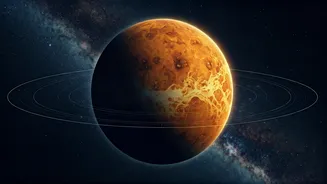
Let’s get the mind-bending maths out of the way first. An orbit is the time a planet takes to travel around the Sun once, defining its year. For Venus, this journey takes about 225 Earth days. Simple enough. But an axial rotation—the time it takes for
the planet to spin once on its axis, defining its day—is a completely different story. Venus completes one full rotation in approximately 243 Earth days. So, yes, you could celebrate your first birthday on Venus before a single Venusian day has even passed. This makes it the slowest-spinning planet in our entire solar system, a lethargic giant hiding in plain sight.
Spinning the Wrong Way
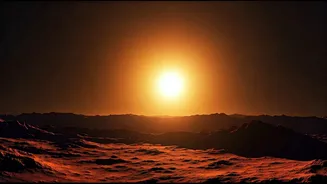
To make things even stranger, Venus spins backwards. Every other planet in our solar system (except for Uranus, which spins on its side) rotates prograde, meaning counter-clockwise when viewed from above the Sun's north pole. This is why on Earth, the Sun rises in the east and sets in the west. Venus, however, has a retrograde rotation. If you could stand on its surface, you would see the Sun rise in the west and set in the east. This backward, incredibly slow spin combines to create a world utterly unlike our own. It’s not just a little different; its fundamental rhythm is the opposite of what we experience.
A 'Day' Versus a 'Solar Day'
Here’s a wrinkle that makes planetary science fascinating. The 243-day rotation is a 'sidereal day'—the time it takes to turn 360 degrees relative to the distant stars. But what we think of as a day, the time from one sunrise to the next, is a 'solar day'. Because Venus is rotating backwards while it moves forwards in its orbit around the Sun, these two motions work against each other. This results in a solar day on Venus that is significantly shorter than its sidereal day, clocking in at around 117 Earth days. So, while a full spin takes 243 days, you'd only have to wait 117 days for the next sunrise. It’s still an incredibly long time to wait for morning.
Why Is Venus So Weird?
Scientists don't have a single, definitive answer, but there are two leading theories. The first involves a colossal cosmic collision. Early in its history, Venus might have been struck by a massive asteroid or protoplanet. Such a powerful impact could have been forceful enough to not just halt its original spin but actually reverse it, leaving it with the slow, retrograde motion we see today. The second theory is more gradual, pointing to Venus's notoriously thick atmosphere. This dense blanket of gas, about 90 times heavier than Earth’s, may have created powerful 'thermal tides'. The Sun’s heat would cause the atmosphere to bulge, and the immense gravitational pull of this atmospheric bulge could have acted as a brake over billions of years, slowly grinding the planet's rotation to a near-standstill and eventually tipping it over.
A World Shaped by Its Slowness
This bizarre rotation has profound consequences. The long days and nights lead to extreme temperature swings, though the thick, insulating atmosphere ensures the entire planet remains a scorching 465°C, hot enough to melt lead. The slow spin also means Venus lacks a protective magnetic field like Earth's. Our planet's rapid rotation helps generate a magnetic field that shields us from harmful solar radiation. Without this shield, Venus's atmosphere is constantly being stripped away by the solar wind. The combination of a crushing atmosphere, acid rain clouds, and a day that outlasts a year makes Venus a truly hellish landscape—a cautionary tale of how planetary evolution can take a very different path.