




The Sky’s Deceptive Blue
We learn early on that the sky is blue, but the reason is a beautiful trick of physics. The sun emits a whole spectrum of light that appears white to our eyes. As this light travels through our atmosphere, it collides with tiny nitrogen and oxygen molecules.
This is where a process called Rayleigh scattering comes in. Blue light, which has a shorter wavelength, is scattered far more effectively by these air molecules than red light, which has a longer wavelength. This scattered blue light comes at our eyes from every direction, which is why the entire daytime sky appears blue. Conversely, during sunrise and sunset, sunlight has to travel through more of the atmosphere to reach us. By that time, most of the blue light has been scattered away from our line of sight, leaving the longer-wavelength reds and oranges to paint the sky.
The World of Structural Colour
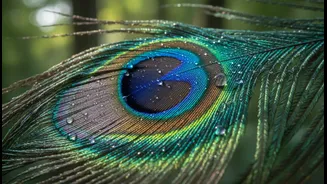
While pigments get their colour by absorbing certain wavelengths of light, structural colour is all about architecture. This phenomenon occurs when a surface is covered in microscopic structures so small that they interfere with visible light, reflecting specific colours. Think of a peacock's feather. It's actually pigmented brown with melanin, but its surface is composed of tiny, intricate structures. These structures cause light waves to reflect and interfere with each other in such a way that only specific, brilliant colours like blue, green, and turquoise are bounced back to our eyes. The same principle is at play in the dazzling wings of many butterflies and the metallic sheen of some beetles. These colours are not painted on; they are engineered with light itself, often appearing iridescent and changing with the viewing angle.
Shimmering, Fleeting Rainbows
You’ve surely seen the mesmerising, rainbow-like patterns on a soap bubble or an oil slick on water. This is a classic example of thin-film interference. Here, light waves reflect off both the top and bottom surfaces of a very thin layer—like the wall of a bubble or the film of oil. Because the light ray bouncing off the bottom surface travels a slightly longer path, the two reflected waves can either reinforce each other (constructive interference) or cancel each other out (destructive interference). Which wavelengths are reinforced depends on the exact thickness of the film. Since a soap bubble’s wall is not uniformly thick, different colours are produced all over its surface, creating the swirling, iridescent patterns we see.
Bending and Splitting Light
Rainbows are perhaps the most famous example of colour created by physics. They are the result of refraction and reflection. When sunlight enters a raindrop, it bends, or refracts, separating into its constituent colours. This light then reflects off the inside back of the raindrop before exiting, refracting again as it leaves. Because each colour bends at a slightly different angle, the white sunlight is split into the familiar spectrum. Diffraction is another related process where light waves bend as they pass around an obstacle or through a narrow opening. The subtle colours sometimes seen at the edge of clouds, known as cloud iridescence, are caused by light diffracting through tiny water droplets or ice crystals.