



The Rise of the Robot Driver
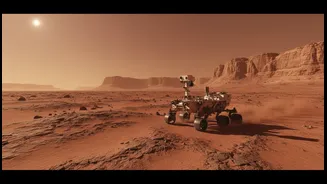
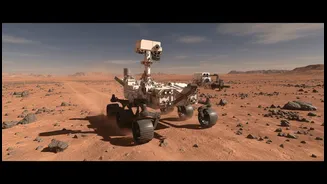
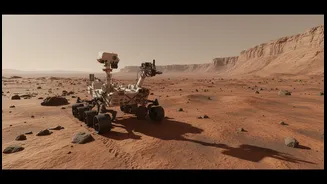
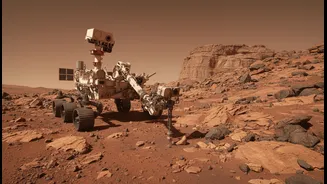
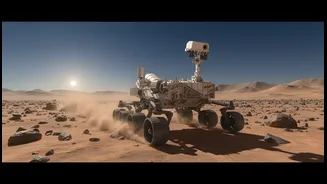
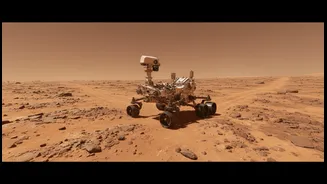
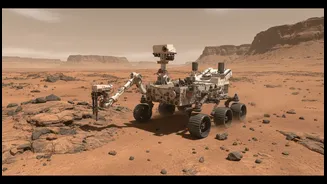
Since landing in Jezero Crater in February 2021, NASA's Perseverance rover has been a game-changer. While its primary mission is to hunt for signs of ancient life and collect samples for a potential return to Earth, its secondary triumph is a revolution
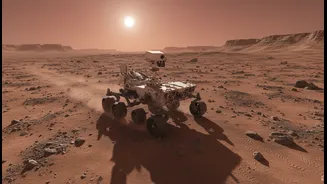
in how we explore other worlds. The rover recently surpassed the marathon distance of 42.2 kilometres on the Martian surface, a feat its predecessor Opportunity took more than twice as long to achieve. The secret to this speed isn't just better wheels; it's a smarter brain. Perseverance is equipped with a sophisticated autonomous navigation system, called AutoNav, that effectively lets it drive itself. Over 90% of the rover's total distance has been covered using this self-driving mode.
Thinking While Driving
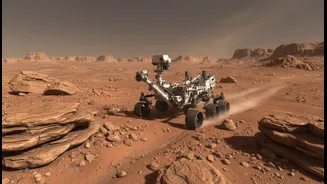
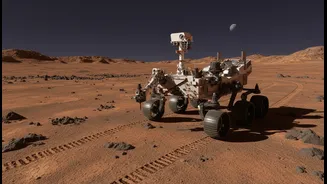
Previous rovers like Spirit, Opportunity, and even the still-active Curiosity had to operate on a stop-and-go basis. They would drive a short distance, halt, take pictures, analyse the terrain, and then proceed. Perseverance's AutoNav, by contrast, can 'think' while in motion. It uses a dedicated computer processor and advanced cameras to create 3D maps of the terrain in front of it, identify hazards like large rocks or sand traps, and plot a safe course, all without pausing. This continuous assessment allows it to navigate tricky landscapes, such as a dense boulder field nicknamed 'Snowdrift Peak,' an estimated 12 Martian days faster than Curiosity could have managed. This enhanced system, known as ENav (Enhanced Autonomous Navigation), uses neural networks to classify terrain in real-time, essentially giving the rover the reflexes to dodge obstacles on its own.
Cutting the Cord to Earth
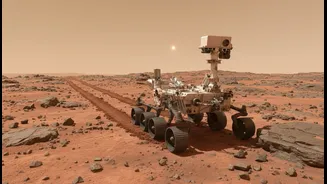
This growing independence is crucial for accelerating the pace of discovery. Every time a rover has to stop and wait for instructions from mission control on Earth, precious time is lost. Recently, this autonomy took another leap forward. In early 2026, NASA successfully tested a new technology called Mars Global Localization. Because there is no GPS on Mars, rovers previously relied on human operators comparing rover images to orbital maps to get a precise location fix. This new system allows Perseverance to do that job itself, comparing its own panoramic images to an onboard orbital map to pinpoint its location to within about 25 centimetres. By knowing exactly where it is, the rover can confidently drive for much longer stretches without needing to phone home for directions, overcoming a major bottleneck in autonomous exploration.
A Blueprint for the Future
The advancements being proven by Perseverance are more than just efficiency upgrades; they are foundational for the future of space exploration. Faster, more independent robotic explorers can cover more scientific ground, investigate more targets, and take on more risks. NASA has even tested using generative AI to plan entire drive routes, further reducing the workload on human operators and potentially streamlining missions. These technologies are not limited to Mars. The ability of a robot to navigate, understand its environment, and make decisions on its own is essential for future missions to the Moon, Europa, and beyond. In fact, NASA is already considering repurposing Perseverance's Earth-bound twin, a rover named OPTIMISM, for a mission to the Moon's south pole. Each record-breaking drive by Perseverance isn't just a number; it's a test run for a future where humanity's robotic emissaries can explore distant worlds with greater speed, intelligence, and independence than ever before.