


A Glimpse of Our Sun’s Future
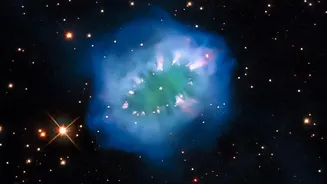
Located about 650 light-years away, the Helix Nebula isn't a nursery for new stars but rather the beautiful, final act of a dying one. It’s a planetary nebula, the expanding, glowing shell of gas shed by a star like our own Sun at the end of its life.
For astronomers, studying it is like getting a preview of our solar system's distant fate, billions of years from now. For decades, telescopes like Hubble have captured its ethereal beauty, showing a vast, colorful ring. But its intricate, inner workings remained shrouded. Webb’s powerful infrared vision, however, cuts through the cosmic dust to show the dynamic process behind the spectacle in stunning new detail.
An Engine of Cosmic Sculpture
The force shaping the nebula is something called a stellar wind. But this isn’t a gentle breeze. Imagine a super-powered leaf blower, but instead of air, it's a torrent of hot gas and radiation blasting away from the dying star’s tiny, super-hot core, known as a white dwarf. In its final stages, the star expelled its outer layers of gas and dust over thousands of years. Now, a newer, faster wind is slamming into that older, slower-moving material. This cosmic collision is what sculpts the nebula, creating the complex structures that Webb can finally see clearly. It’s a chaotic, powerful process that turns a star's last breath into a masterpiece of cosmic art.
What Webb's Infrared Eye Uncovered
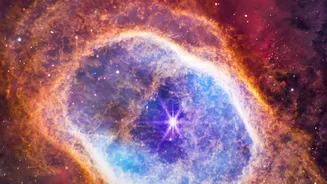
Previous images showed a ghostly glow, but Webb’s NIRCam (Near-Infrared Camera) instrument brings the nebula’s structure into sharp focus. The new images highlight thousands of previously unseen, comet-like filaments, each a dense knot of gas with a tail stretching away from the central star. These are formed where the blistering hot stellar wind crashes into the cooler, older shells of gas. Webb’s view makes these knots the star of the show, revealing them in far greater numbers and clarity than ever before. The different colors in the image represent temperature and chemistry: hot, energized gas glows blue, while cooler molecular gas and dust appear in yellow and red hues, tracing the raw ingredients for future stars and planets.
Rewriting the Story of a Dying Star
This unprecedented detail does more than create a pretty picture; it helps refine our understanding of how planetary nebulae evolve. By seeing the stark transition between the hot inner gas and the cooler outer material, scientists can better model the physics of these stellar winds. The images show that the process of a star recycling its material back into the cosmos is far more intricate and clumpy than a smooth, uniform expansion. These observations provide a crucial data point, allowing scientists to test their theories about how dying stars seed the universe with enriched material that will eventually form new worlds. It transforms our view of the Helix Nebula from a static object into a dynamic, evolving environment, caught in the act of creation and destruction.