


A New Kind of Solar Telescope
Imagine trying to listen to a whisper in a hurricane. That’s the challenge for scientists studying the Sun’s powerful eruptions from Earth. Our planet's ionosphere blocks the low-frequency radio waves that are key to understanding these events. NASA’s
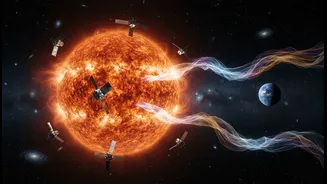
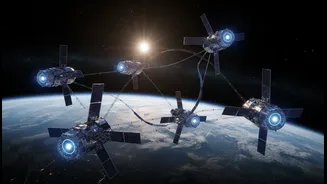
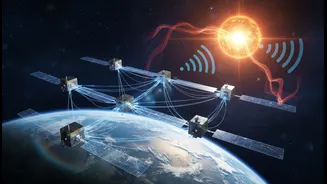
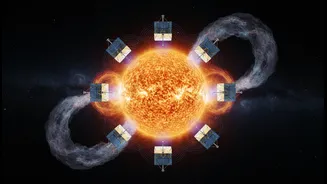
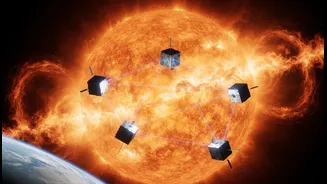
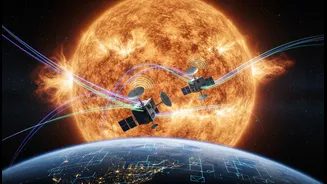
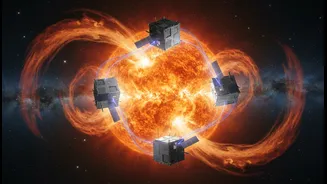
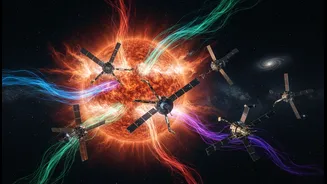
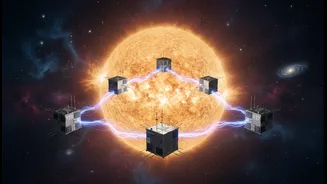
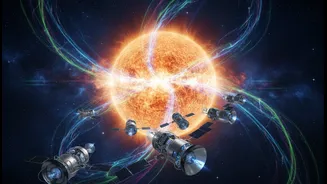
Sun Radio Interferometer Space Experiment, or SunRISE, offers a clever solution. Instead of one giant, expensive satellite, the mission consists of a fleet of six CubeSats, each about the size of a toaster oven. These small satellites will fly in formation high above Earth, arranged about 10 kilometers apart. Working together, they will function as a single, vast virtual radio telescope, a technique known as interferometry. This allows them to observe the low-frequency signals from the Sun that are invisible from the ground, offering an unprecedented view of solar phenomena.
Tuning In to Solar Radio Bursts
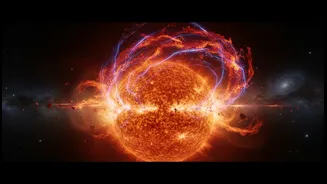
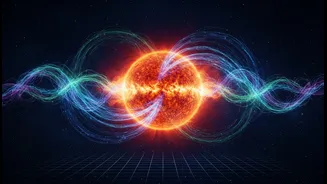
The main target for SunRISE are solar radio bursts, specifically a kind called Type II bursts. These are intense emissions of radio waves produced during massive solar events like coronal mass ejections (CMEs). A CME is a huge expulsion of plasma and magnetic field from the Sun's corona. When this eruption travels through space, it creates a shockwave that accelerates electrons, causing them to emit powerful radio signals. These Type II bursts act like a cosmic smoke signal, heralding the arrival of a potentially hazardous solar storm. Until now, scientists could detect these bursts but couldn't pinpoint their exact location on the Sun. SunRISE will change that by creating 3D maps that trace where a burst originates and how it expands into space, providing a crucial missing piece of the space weather puzzle.
Why Space Weather Matters on Earth
While solar storms create beautiful auroras, their effects can be far more disruptive. A powerful CME directed at Earth can trigger a geomagnetic storm, threatening the high-tech infrastructure our modern world depends on. These storms can induce extra electrical currents in power grids, potentially leading to widespread blackouts like the one that hit Quebec in 1989. They can also damage satellites, disrupt GPS signals causing navigation errors, and interfere with high-frequency radio communications used by airlines and emergency services. Energetic particles from the sun are also a significant radiation hazard for astronauts in space. By studying the radio bursts that often precede these events, SunRISE aims to provide earlier and more accurate warnings, giving operators time to protect satellites and stabilize power grids.
The Journey to the Launchpad
The SunRISE mission has been in development for several years, with the six satellites built and ready for flight. Originally scheduled to launch on a United Launch Alliance Vulcan Centaur rocket, NASA announced in July 2026 that the mission would move to a SpaceX Falcon Heavy rocket. This change was made to ensure the mission could launch in a timely manner, though a new, specific date has yet to be finalized. The six CubeSats will be deployed as a rideshare, hitching a lift with a primary payload sponsored by the U.S. Space Force. Once in their geosynchronous orbit, the small satellites will begin their 12-month mission to listen to the Sun's secrets, providing data that complements other major solar observatories like the Parker Solar Probe and Solar Orbiter.