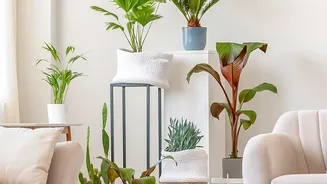







The Reality of Screen Fatigue
If your workday ends with tired eyes, a headache, and a feeling of mental drain, you are not alone. This is digital fatigue, and it’s a direct consequence of spending prolonged hours staring at screens. The constant focus demanded by our laptops and phones
fatigues the muscles in our eyes and the attention centres of our brain. In compact home-office setups, where the space is often small and the view is limited to a wall, this effect can be magnified, leading to reduced productivity, increased irritability, and burnout. While taking breaks is essential, science shows that what you look at during those breaks matters just as much.
Nature's Cure: Understanding Biophilia
Humans have an innate tendency to seek connections with nature, a concept known as 'biophilia'. For millennia, we evolved in natural environments, and our brains are wired to respond positively to them. Modern life, especially in urban settings, has largely disconnected us from the natural world, but our inherent need for it remains. Biophilic design aims to reintroduce natural elements like plants, water, and natural light into our indoor spaces. Research shows that even small doses of nature can significantly lower stress, improve mood, and enhance cognitive function. A simple houseplant on your desk is a micro-dose of nature, and its benefits are surprisingly powerful.
How Greenery Resets Your Brain
The magic behind this effect is explained by Attention Restoration Theory (ART). According to ART, our capacity for focused, 'directed attention'—the kind we use for work tasks—is a limited resource that gets depleted. When it runs low, we feel mentally tired and struggle to concentrate. Nature, however, engages our 'soft fascination', a type of effortless attention that allows our directed-attention capabilities to rest and recharge. Gazing at the intricate patterns of a leaf or the gentle sway of a fern provides a restorative visual break that is more effective than staring at a blank wall. This brief mental pause helps to restore your focus and combat the drain of digital work.
Lower Stress, Better Focus
The benefits are not just psychological; they are physiological too. Studies have shown that the presence of plants can reduce levels of cortisol, the body's primary stress hormone. One study found that participants' heart rates were lower when a plant was placed on their desk, indicating a calming effect. Another study demonstrated that workers in offices with plants were 12% more productive and reported feeling less stressed. Plants can also help by improving indoor air quality and regulating humidity, which can alleviate physical discomforts like dry eyes and skin irritation, especially in air-conditioned rooms.
Choosing Your Green Desk Companion
You don’t need a jungle to reap the rewards; a single plant can make a difference. For a compact work-from-home setup, especially in apartments with limited natural light, it's best to choose low-maintenance varieties. The Snake Plant (Sansevieria trifasciata) is an excellent choice as it purifies the air and is incredibly resilient. The ZZ Plant (Zamioculcas zamiifolia) is another nearly indestructible option with glossy leaves that thrives in low light. Pothos (Epipremnum aureum) is a forgiving trailing vine that adds a lovely cascade of green, while Aglaonemas come in various colours and are well-suited for rooms with little to no window light.
Smart Placement for Maximum Impact
Where you place your plant matters. To effectively combat digital fatigue, position your greenery within your field of vision but not in a way that obstructs your work. The goal is to make it easy to follow the popular '20-20-20' rule: every 20 minutes, look at something 20 feet away for 20 seconds. Placing a plant at a distance or to the side of your monitor makes it a perfect, restorative focal point for these micro-breaks. Having it in your peripheral vision provides a constant, subtle connection to nature that helps create a calming atmosphere, turning your workspace from a sterile box into a small sanctuary of well-being.