


A Priceless Glimpse of the Corona
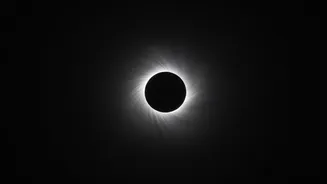
A total solar eclipse happens when the Moon passes directly between the Earth and the Sun, completely blocking the Sun's brilliant face. This brief period of darkness, or totality, is scientifically invaluable because it reveals the Sun's outer atmosphere,
the corona. Normally, the corona is invisible, drowned out by the Sun's overwhelming brightness. But during an eclipse, this faint, pearly halo shines forth in all its glory, showing intricate streams and loops of plasma shaped by the Sun's powerful magnetic field. Scientists cherish these rare events as they offer a unique, unobstructed view from Earth that helps them tackle some of the biggest mysteries of solar physics.
Tackling the Coronal Heating Puzzle
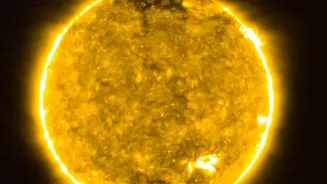
One of the most persistent questions about the Sun is the coronal heating problem. The Sun's visible surface, the photosphere, is about 5,500 degrees Celsius, but the corona above it sizzles at temperatures of a million degrees or more. It’s a puzzle that defies simple explanation. The 2026 eclipse provided new, high-resolution data on the structures and dynamics right at the base of the corona. By studying images and spectral data captured during the moments of totality, researchers hope to better understand how energy is transferred from the Sun's surface and deposited into the corona to heat it to such extreme temperatures. Observations from high-altitude jets and ground-based telescopes during this event will feed into complex models that aim to finally solve this counterintuitive phenomenon.
Predicting the Sun's Fiery Mood
Leading up to the eclipse, scientists, including a team from India's Raman Research Institute, made detailed predictions of what the corona's structure would look like. These models use data on the Sun's surface magnetic fields to forecast the shape of the corona, expecting to see complex, petal-like streamers. The actual observations during the eclipse serve as a crucial test for these predictive models. Comparing the predictions to the reality helps refine the models that are essential for understanding and forecasting space weather events like solar flares and coronal mass ejections (CMEs). These solar storms can send powerful bursts of energy and particles toward Earth, potentially disrupting satellites, communication networks, and power grids.
A Team Effort with Space Probes
The 2026 eclipse was not just an event for ground-based observers. It was a coordinated effort involving some of our most advanced solar spacecraft. Missions like the European Space Agency's Solar Orbiter and Proba-3, which can create its own artificial eclipses, worked in tandem with the natural event. While ground-based telescopes captured a detailed view from one angle, these space probes provided a wider context, observing the Sun from different viewpoints. For example, NASA flew a high-altitude WB-57 research aircraft along the eclipse path to extend the viewing time of totality and capture data that is impossible to get from the ground. This synergy provides a more complete, three-dimensional understanding of the solar wind and the magnetic structures that drive it.
Studying Earth's Atmospheric Response
The eclipse's impact wasn't limited to the Sun. As the Moon's shadow raced across the Earth, it caused rapid, localized changes in our own atmosphere. Teams in Iceland and Spain launched dozens of scientific balloons before, during, and after the event to measure these changes. They studied how the sudden drop in sunlight and temperature affected the 'boundary layer'—the part of the atmosphere closest to the ground. Data from similar experiments during the 2024 eclipse showed that this layer can collapse in clear skies. The 2026 event provided more data to understand this atmospheric response, which has implications for weather modeling and understanding how Earth's systems react to changes in solar radiation.