







The Pacific's Global Puppeteers
At its heart, the story of El Niño and La Niña is about a massive, slow-motion dance of warm and cool water in the tropical Pacific Ocean. This phenomenon is called the El Niño-Southern Oscillation, or ENSO. In a normal, or 'neutral,' year, strong trade
winds blow from east to west across the Pacific, pushing warm surface water towards Asia and Australia. This allows cooler, nutrient-rich water to rise up from the depths near South America. This cycle creates a stable atmospheric pattern that influences weather worldwide, including India's monsoon.
El Niño: When the Pacific Runs a Fever
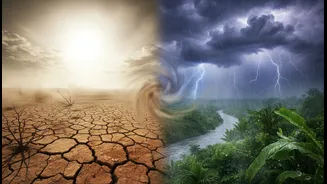
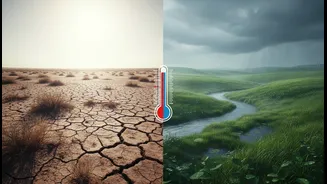
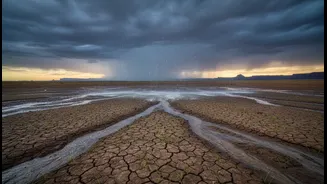
El Niño, which means 'the boy child' in Spanish, occurs when those east-to-west trade winds weaken or even reverse. This allows the massive pool of warm water normally found in the western Pacific to slosh back eastward, toward South America. This warming of the central and eastern Pacific Ocean disrupts weather patterns globally. For India, an El Niño event is often bad news. The altered atmospheric circulation can suppress the development of monsoon winds, leading to weaker rainfall and, in many cases, drought conditions. Historically, many of India's significant drought years have coincided with El Niño events, threatening crop yields, rural incomes, and water security.
La Niña: A Welcome Cool Down
La Niña, meaning 'the little girl,' is the opposite. During a La Niña event, the trade winds become even stronger than usual, pushing more warm water toward the western Pacific. This causes cooler-than-average water to surface in the eastern Pacific. For India, La Niña is typically a blessing. The atmospheric conditions it creates are generally favorable for a strong and healthy southwest monsoon. This often translates to above-average rainfall across the country, which is vital for filling reservoirs and ensuring a good harvest for Kharif crops like rice and pulses.
The Wild Card: The Indian Ocean Dipole
While the El Niño-La Niña cycle is a major driver, it's not the only factor. The Indian Ocean has its own version of this phenomenon called the Indian Ocean Dipole (IOD), sometimes called the 'Indian Niño'. The IOD refers to the temperature difference between the western Arabian Sea and the eastern Indian Ocean off the coast of Indonesia. A 'positive' IOD, with warmer waters in the Arabian Sea, can help boost monsoon rains over India. Crucially, a strong positive IOD can sometimes counteract the negative effects of an El Niño, leading to a normal monsoon even in an El Niño year. Conversely, a 'negative' IOD can worsen drought conditions, especially if it coincides with El Niño.
Why This Global Weather Drama Matters to India
The performance of the monsoon is inextricably linked to India's economic health. The agricultural sector, which employs a vast portion of the population, is heavily dependent on these seasonal rains. A weak monsoon triggered by El Niño can lead to lower crop output, which can drive up food inflation, strain rural household incomes, and reduce demand for goods and services across the economy. It can also impact hydropower generation. A strong monsoon, often aided by La Niña, supports agricultural growth, keeps food prices in check, and contributes to overall economic stability. Understanding these global climate patterns is therefore crucial for forecasting India's economic trajectory and managing its resources.