







What Was CAPSTONE?
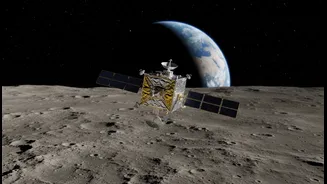
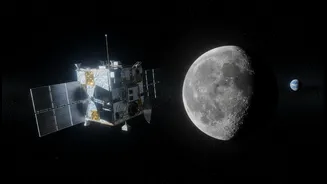
CAPSTONE, short for Cislunar Autonomous Positioning System Technology Operations and Navigation Experiment, was a 55-pound CubeSat with an outsized job. Launched in June 2022, its primary task was to be the first spacecraft ever to fly in a very special
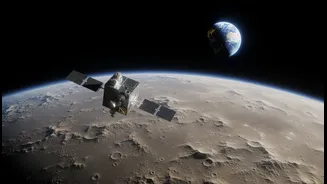
path around the Moon called a near-rectilinear halo orbit, or NRHO. This highly elliptical orbit is located at a gravitational balance point between the Earth and the Moon, offering stability that requires minimal fuel to maintain—a huge advantage for long-term missions. Owned and operated by the company Advanced Space for NASA, this relatively low-cost commercial mission was designed to test the realities of this orbit before committing much larger, more expensive assets.
A Trailblazer for the Lunar Gateway
The reason this specific orbit matters so much is because it is the planned home for the Gateway, a future space station that will orbit the Moon and serve as a staging point for NASA's Artemis missions. The Gateway is a critical piece of infrastructure for establishing a sustained human presence on the Moon and preparing for eventual missions to Mars. Before sending a multi-billion-dollar station into this untested orbit, NASA needed to verify its models. CAPSTONE served as that crucial pathfinder, demonstrating how to enter and maintain the orbit, and confirming the power and propulsion requirements needed to stay there, thus reducing logistical uncertainty for the Gateway program.
Overcoming On-Orbit Challenges
The mission wasn't without its share of drama. Shortly after launch, the team faced communications issues and later a valve problem that sent the tiny spacecraft tumbling through space. For a month, engineers on the ground worked tirelessly to diagnose the problem and develop a recovery plan. Their success in regaining control and salvaging the mission was a powerful testament to the skill of the operations team and provided invaluable experience in deep-space anomaly recovery for small satellites. These early challenges only made the mission's ultimate success more impressive.
Navigation and Engineering Successes
After completing its six-month primary mission, CAPSTONE entered an extended phase that lasted over a year, transforming it into a flexible testbed for new technologies. A key achievement was testing the Cislunar Autonomous Positioning System (CAPS), a navigation technology designed to allow spacecraft to determine their position without relying on ground stations on Earth. CAPSTONE demonstrated this by communicating directly with NASA's Lunar Reconnaissance Orbiter (LRO), a critical step toward creating a GPS-like network at the Moon. The extended mission also validated software-defined satellite systems and autonomous maneuver planning, demonstrating that a spacecraft's capabilities can be upgraded and expanded even after it's in deep space.
The Legacy for Future Missions
NASA officially concluded its activities with CAPSTONE in June 2026, having achieved all of its primary and extended goals. The data and experience gathered have fundamentally lowered the risk for all future lunar endeavors. By proving the stability of the NRHO, demonstrating autonomous navigation, and validating new communication methods like delay-tolerant networking, CAPSTONE has paved the way for a more crowded and complex cislunar environment. The mission showed that small, affordable commercial satellites can perform critical pathfinding work, providing a new model for exploration. Advanced Space will continue to operate the spacecraft, using it as a testbed for future technology development.