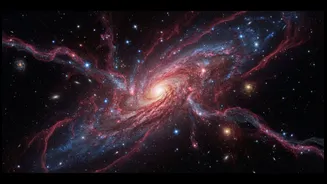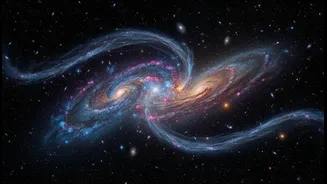




Cosmic Giants on a Collision Course
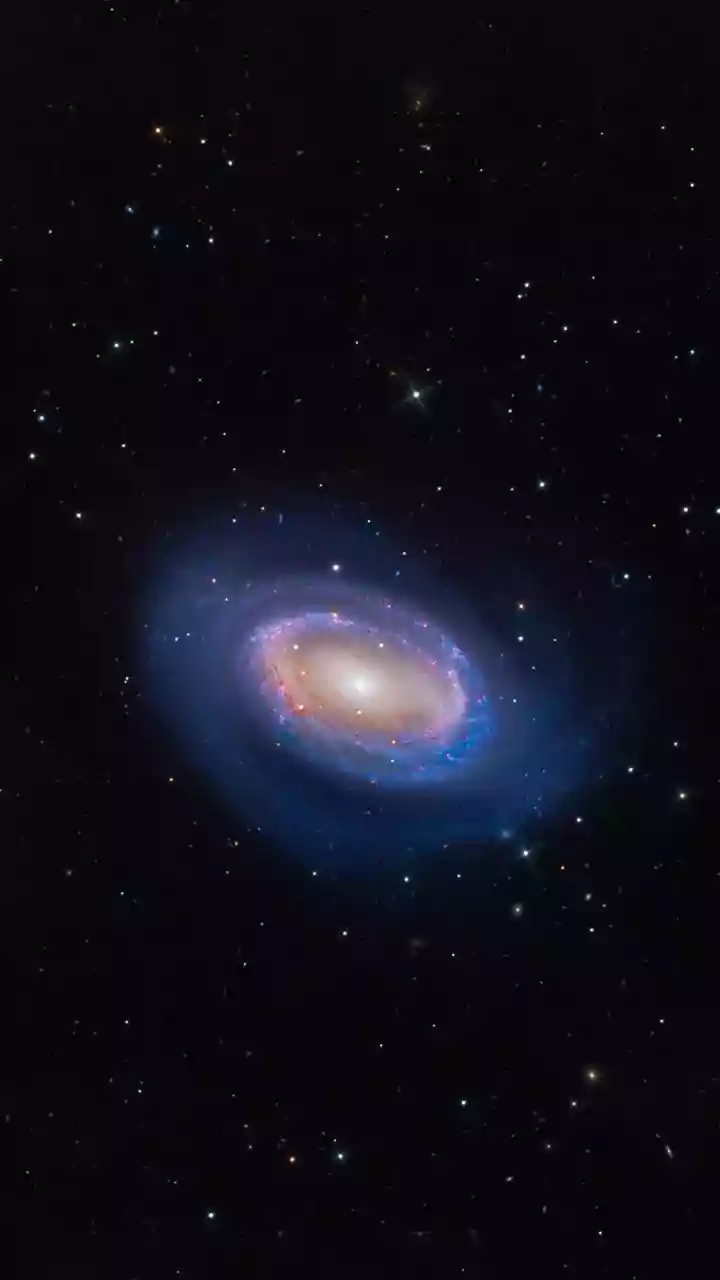
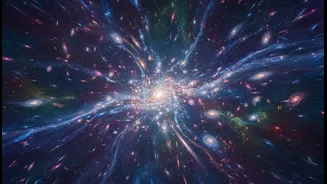
Imagine structures so massive they contain hundreds or even thousands of galaxies, like our own Milky Way, all bound together by gravity. These are galaxy clusters, the largest gravitationally bound objects in the universe. They aren't just collections
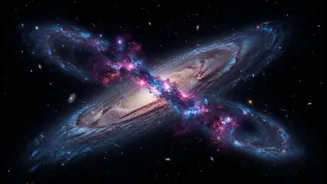
of stars; they are also filled with vast clouds of hot gas, called the intracluster medium (ICM), and are dominated by the mysterious pull of dark matter. According to our leading cosmological models, the universe is built hierarchically, meaning smaller structures merge over cosmic time to form larger ones. This process is ongoing, and when two of these galactic titans are drawn together by gravity, they engage in a slow-motion collision that can take hundreds of millions of years to complete.
Why Infrared Vision is Key
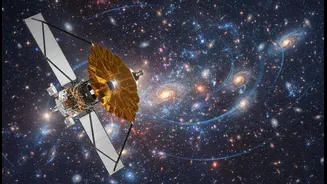
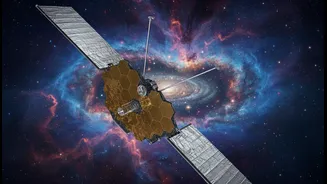
Observing these mergers presents a major challenge. The universe is a dusty place, and these clouds of cosmic dust act like a thick fog, scattering and blocking visible light. This makes it impossible for traditional optical telescopes to get a clear picture of the action, especially in the dense, frantic cores of merging galaxies where new stars are being born at a furious rate. This is where infrared light becomes a superpower for astronomers. With its longer wavelength, infrared radiation can pass through these dense dust clouds largely unobstructed, allowing us to peer into the heart of these cosmic collisions. Modern marvels like the James Webb Space Telescope (JWST) are designed specifically with powerful infrared instruments to give us this unprecedented view.
Introducing Spectrometry: The Universe’s Fingerprint Kit
Seeing the merger in infrared is one thing, but understanding the physics at play is another. This is the role of spectrometry. A spectrometer is an instrument that takes light and breaks it down into its constituent wavelengths, much like a prism creates a rainbow. The resulting spectrum is not a smooth band of colour; it has bright lines (emission lines) and dark lines (absorption lines). Each chemical element and molecule has a unique spectral 'fingerprint', allowing astronomers to identify the chemical composition of distant objects. By analysing these fingerprints, we can determine the temperature, density, and velocity of the gas involved in the collision.
Decoding the Energetic Footprints
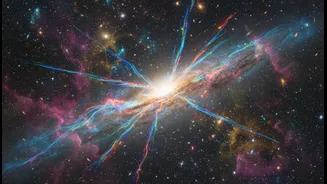
When galaxy clusters collide at speeds of thousands of kilometres per second, they unleash an incredible amount of energy. This violence creates gigantic shock waves that ripple through the intracluster gas, heating it to millions of degrees. These shock waves are one of the key 'energetic footprints' that infrared spectrometry helps us capture. By analysing the spectral data from the gas, scientists can measure the temperature jump across a shock front, which in turn reveals the speed and power of the shock wave. Another footprint is turbulence. The merger churns the gas, creating chaotic, swirling motions. Spectrometry can detect the Doppler shifts in the light from this turbulent gas, revealing how it is moving. These energetic footprints tell a story of cosmic weather on the grandest scale, helping scientists test theories about plasma physics and magnetic fields in conditions impossible to replicate on Earth.
What These Collisions Teach Us
Studying these mergers isn't just about watching a cosmic fireworks display. These events are fundamental to understanding how the universe evolved. They show how the large-scale structure we see today was assembled. They also trigger massive bursts of star formation, and the intense dynamics can fuel the growth of the supermassive black holes that lurk at the centres of most large galaxies. Recent discoveries, some made with the JWST, are revealing surprisingly mature and massive galaxy clusters in the early universe, challenging and refining our models of cosmic evolution. By capturing the energetic footprints of these ancient collisions, infrared spectrometry provides crucial data that helps piece together the history of the cosmos, from the Big Bang to the present day.