



A Sweet Discovery in the Cosmic Soup
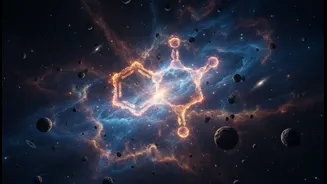
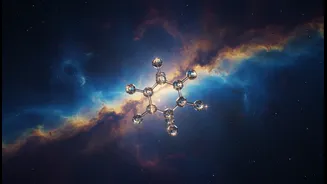
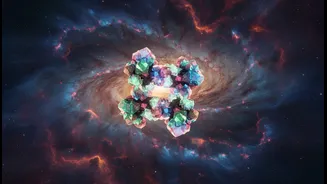
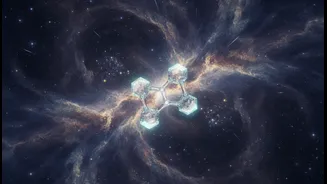
Astronomers have made a groundbreaking detection: for the first time, a true sugar molecule has been found floating in the vastness of interstellar space. The molecule, called erythrulose, was identified in a dense, chaotic cloud of gas and dust known
as G+0.693−0.027, located near the center of our Milky Way galaxy. This region is a stellar nursery, a turbulent environment where new stars are born. Finding a relatively complex four-carbon sugar here is like discovering a fully assembled gear in a mine full of raw iron ore—it suggests a surprisingly sophisticated manufacturing process is at play in the cosmos. On Earth, this same sugar is naturally found in raspberries, but its presence 27,000 light-years away has far greater implications.
Listening to Molecules Across the Galaxy
Scientists didn't see the molecule directly with a traditional telescope. Instead, they used powerful radio telescopes, including the 40-m Yebes radio telescope in Spain and the 30-m IRAM telescope. These instruments act like giant ears, tuning into the faint radio waves that molecules emit as they rotate and vibrate in the cold of space. Each type of molecule has a unique spectral 'fingerprint,' a specific set of frequencies it radiates. By painstakingly scanning the signals coming from the galactic center and matching them to the known fingerprint of erythrulose, astronomers could confirm the sugar's presence from trillions of kilometres away. This method of spectral analysis is crucial for mapping the galaxy's hidden chemical inventory.
Why This Finding Is a Game-Changer
The discovery is significant because sugars are fundamental building blocks of life. They form the backbone of RNA and DNA and are crucial for metabolic processes. While this isn't evidence of alien life, it confirms that some of the key ingredients for life can form in interstellar space, well before planets even exist. This supports the theory that comets and asteroids, which form from this same interstellar material, could have 'seeded' a young Earth with the prebiotic molecules needed for life to emerge. The discovery of erythrulose was also unexpected because it challenges the long-held view that complex molecules in space form by adding one carbon atom at a time. The sugar appears to be more abundant than simpler three-carbon sugars, suggesting alternative, more complex formation pathways may be at work.
A Pattern of Growing Complexity
This discovery is not an isolated incident. In recent years, astronomers using powerful observatories like the Atacama Large Millimeter/submillimeter Array (ALMA) and the James Webb Space Telescope (JWST) have found an increasing variety of complex organic molecules (COMs) in space. These range from simple alcohols and the branched molecules that form the basis of amino acids to ring-shaped molecules containing sulfur. Scientists have detected these compounds in the cold, dark clouds that predate stars, in the swirling protoplanetary disks where planets are born, and even surviving the harsh environment of a supernova remnant. Each discovery pushes back against the old idea of space as a simple void, revealing a dynamic and rich chemical network capable of creating remarkable complexity.
From Stardust to Us
The material swirling in these giant molecular clouds is the very same stardust from which our own Sun and planets were born 4.5 billion years ago. The chemical journey that starts in a cold, dark cloud like G+0.693−0.027 doesn't end there. Over millions of years, gravity pulls this enriched material together to form new solar systems. The complex molecules, including sugars like erythrulose, get frozen into comets and asteroids. These celestial bodies can then deliver their precious cargo to young, rocky planets. By studying the chemistry of our galaxy today, we are essentially looking at a snapshot of the conditions that likely gave rise to our own world, connecting the vastness of space to our own origins.