


The Tale of a Runaway Greenhouse
Venus today is the hottest planet in our solar system, with surface temperatures hot enough to melt lead and an atmosphere 90 times denser than Earth's, composed mostly of carbon dioxide. Scientists believe it wasn't always this way. Understanding why
and how Venus transformed from a potentially habitable world into a scorching hothouse is a key scientific objective. This runaway greenhouse effect serves as a crucial natural laboratory for studying climate change, offering invaluable lessons about the delicate balance that makes a planet like Earth habitable. By studying Venus, we can better model Earth's own climate and understand the potential consequences of atmospheric changes.
ISRO's Mission to Uncover Venus's Secrets
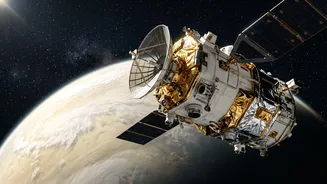
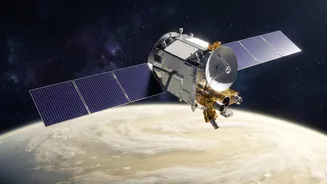
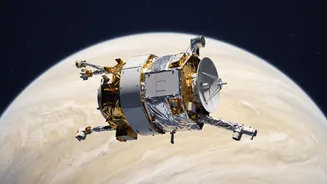
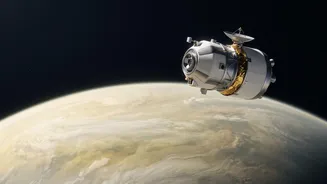
Formally approved by the Indian government in September 2024, the Shukrayaan-1 mission is scheduled for launch on March 29, 2028, aboard the powerful LVM-3 rocket. The spacecraft, carrying a payload of about 100 kg, will embark on a 112-day journey to enter an elliptical orbit around Venus. This mission is ISRO's second interplanetary venture after the highly successful Mars Orbiter Mission (Mangalyaan). The primary goals are to investigate Venus's surface and sub-surface, study its atmospheric chemistry and dynamics, and analyze the interaction between the Venusian ionosphere and the solar wind.
A Toolkit for a Toxic Atmosphere
To peer through the dense sulfuric acid clouds and analyze the complex atmospheric chemistry, Shukrayaan-1 will be equipped with a suite of sophisticated Indian and international instruments. While a high-resolution Synthetic Aperture Radar (SAR) will map the surface, a number of other sensors are dedicated specifically to the atmosphere. These include thermal cameras to map cloud-top temperatures, spectrometers to analyze atmospheric composition, and lightning detectors. The mission will also employ aerobraking—using the drag of the planet's upper atmosphere to gradually lower its orbit—a first for ISRO and a key technology demonstration.
International Collaboration and Key Instruments
Shukrayaan-1 is a global collaboration, featuring 16 Indian payloads alongside contributions from Russia, France, Sweden, and Germany. One key instrument is the Venus Infrared Atmospheric Gases Linker (VIRAL), jointly developed by Russia's space research institute and French laboratories, which will study the atmospheric composition. Another is the Venusian Neutrals Analyser, provided by the Swedish Institute of Space Physics, which will study how the solar wind strips away particles from the atmosphere. These instruments will provide a comprehensive picture of the planet's atmospheric processes, from its cloud tops down to its lower layers.
The Search for Answers
The atmospheric sensors will seek answers to several outstanding questions. They will investigate the mysterious super-rotation of the Venusian atmosphere, where the clouds circle the planet sixty times faster than the planet itself rotates. They will also analyze the chemical composition, looking for trace gases and clues about active volcanism. Following the potential detection of phosphine gas in Venus's clouds in 2020—a possible, though highly debated, biosignature—instruments like VIRAL are equipped to conduct a more thorough search. Whether it confirms past theories or delivers entirely new surprises, Shukrayaan's atmospheric study is set to redefine our understanding of our nearest planetary neighbour.